Citation: Peter Muturi, Junping Yu, Alice Nyambura Maina, Samuel Kariuki, Francis B. Mwaura, Hongping Wei. Bacteriophages Isolated in China for the Control of Pectobacterium carotovorum Causing Potato Soft Rot in Kenya .VIROLOGICA SINICA, 2019, 34(3) : 287-294.  http://dx.doi.org/10.1007/s12250-019-00091-7

Bacteriophages Isolated in China for the Control of Pectobacterium carotovorum Causing Potato Soft Rot in Kenya

cstr: 32224.14.s12250-019-00091-7
  • Corresponding author: Hongping Wei, hpwei@wh.iov.cn, ORCID: 0000-0002-9948-8880
  • Received Date: 03 August 2018
    Accepted Date: 10 December 2018
    Published Date: 13 March 2019
    Available online: 01 June 2019
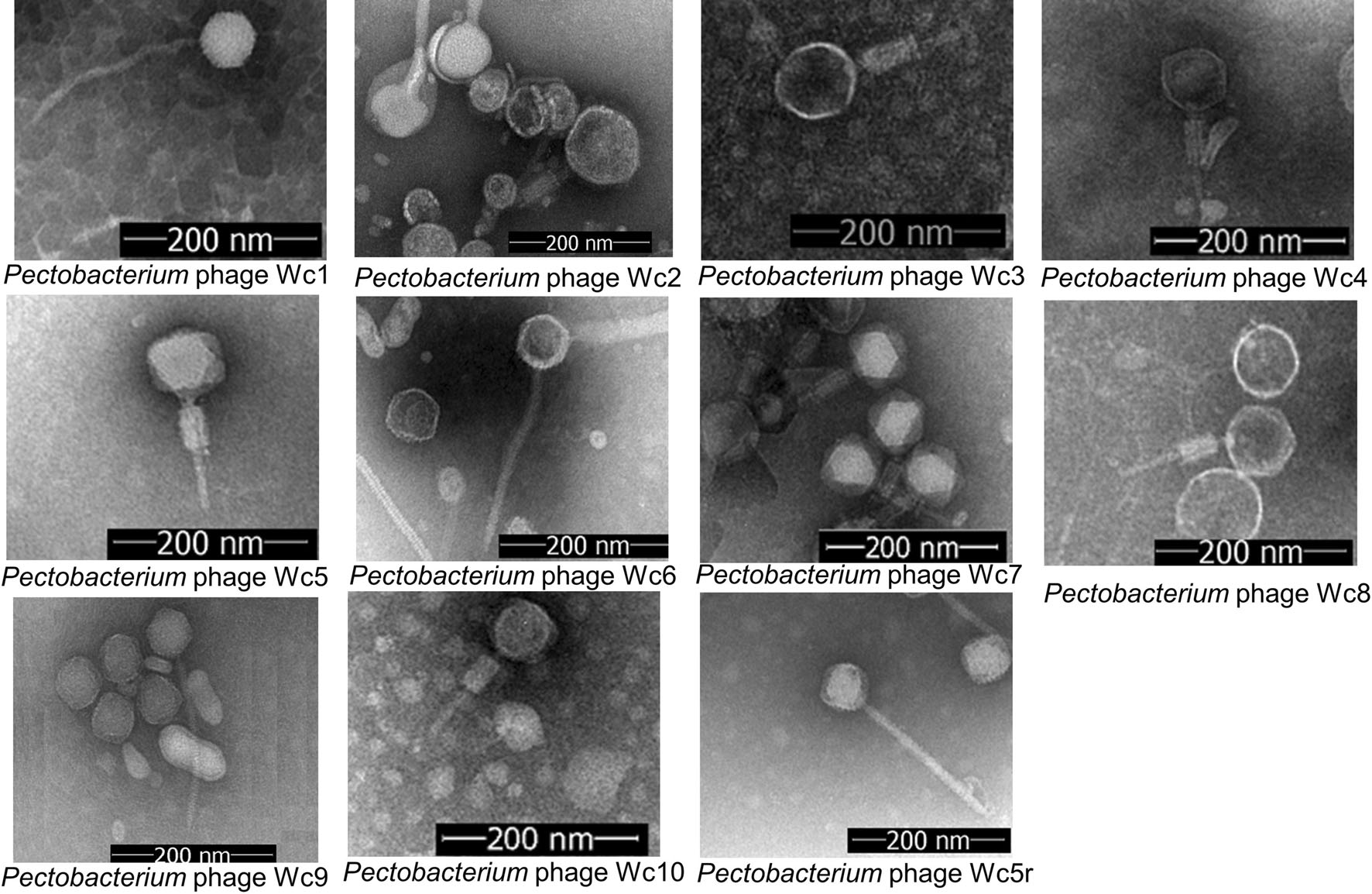
  • Soft rot is an economically significant disease in potato and one of the major threats to sustainable potato production. This study aimed at isolating lytic bacteriophages and evaluating methods for and the efficacy of applying phages to control potato soft rot caused by Pectobacterium carotovorum. Eleven bacteriophages isolated from soil and water samples collected in Wuhan, China, were used to infect P. carotovorum host strains isolated from potato tubers showing soft rot symptoms in Nakuru county, Kenya. The efficacy of the phages in controlling soft rot disease was evaluated by applying individual phage strains or a phage cocktail on potato slices and tubers at different time points before or after inoculation with a P. carotovorum strain. The phages could lyse 20 strains of P. carotovorum, but not Pseudomonas fluorescens control strains. Among the 11 phages, Pectobacterium phage Wc5r, interestingly showed cross-activity against Pectobacterium atrosepticum and two phage-resistant P. carotovorum strains. Potato slice assays showed that the phage concentration and timing of application are crucial factors for effective soft rot control. Phage cocktail applied at a concentration of 1×10⁹ plaque-forming units per milliliter before or within an hour after bacterial inoculation on potato slices, resulted in ≥ 90% reduction of soft rot symptoms. This study provides a basis for the development and application of phages to reduce the impact of potato soft rot disease.

  • 加载中
  • 10.1007s12250-019-00091-7-ESM1.pdf
    1. Adriaenssens EM, Van Vaerenbergh J, Vandenheuvel D, Dunon V, Ceyssens P-J, De Proft M, Kropinski AM, Noben J-P, Maes M, Lavigne R (2012) T4-related bacteriophage LIMEstone isolates for the control of soft rot on potato caused by 'Dickeya solani'. PLOS One 7:e33227
        doi: 10.1371/journal.pone.0033227

    2. Buttimer C, McAuliffe O, Ross RP, Hill C, O’Mahony J, Coffey A (2017) Bacteriophages and bacterial plant diseases. Front Microbiol. https://doi.org/10.3389/fmicb.2017.00034
        doi: 10.3389/fmicb.2017.00034

    3. Chan BK, Abedon ST (2012) Phage therapy pharmacology: phage cocktails. Adv Appl Microbiol 78:1–23
        doi: 10.1002/prot.v80.1

    4. Czajkowski R, Ozymko Z, Lojkowska E (2014) Isolation and characterization of novel soilborne lytic bacteriophages infecting Dickeya spp. biovar 3 ('D. solani'). Plant Pathol 63:758-772
        doi: 10.1111/ppa.2014.63.issue-4

    5. Darrasse A, Priou S, Kotoujansky A, Bertheau Y (1994) PCR and restriction fragment length polymorphism of a pel gene as a tool to identify Erwinia carotovora in relation to potato diseases. Appl Environ Microbiol 60:1437-1443

    6. Davidson RS (1948) Factors affecting the development of bacterial soft rot of potato tuber initials. Dissertation, University of Minnesota

    7. De Boer S (2008) Managing soft rot and ring rot. In: DA Johnson (ed) Potato Health Management, APS Press, St Paul, pp171-181

    8. de Haan EG, Dekker-Nooren TC, van den Bovenkamp GW, Speksnijder AG, van der Zouwen PS, van der Wolf JM (2008) Pectobacterium carotovorum subsp. carotovorum can cause potato blackleg in temperate climates. Eur J Plant Pathol 122:561
        doi: 10.1007/s10658-008-9325-y

    9. del Pilar Marquez-Villavicencio M, Weber B, Witherell RA, Willis DK, Charkowski AO (2011) The 3-hydroxy-2-butanone pathway is required for Pectobacterium carotovorum pathogenesis. PLOS One 6:e22974
        doi: 10.1371/journal.pone.0022974

    10. Ellis EL, Delbrück M (1939) The growth of bacteriophage. J General Physiology 22:365-384
        doi: 10.1085/jgp.22.3.365

    11. FAO STAT (2013) Food and agriculture organization of the United Nations. Statistical database

    12. Fister S, Robben C, Witte AK, Schoder D, Wagner M, Rossmanith P (2016) Influence of Environmental Factors on Phage-Bacteria Interaction and on the Efficacy and Infectivity of Phage P100. Front Microbiol 7:1152

    13. Frampton RA, Pitman AR, Fineran PC (2012) Advances in bacteriophage-mediated control of plant pathogens. Int J Microbiol 2012:326452

    14. Hadas H, Einav M, Fishov, I, Zaritsky A (1997) Bacteriophage T4 development depends on the physiology of its host Escherichia coli. Microbiology 143:179–185

    15. Iriarte FB, Obradović A, Wernsing MH, Jackson LE, Balogh B, Hong JA, Vallad GE (2012) Soil-based systemic delivery and phyllosphere in vivo propagation of bacteriophages: two possible strategies for improving bacteriophage persistence for plant disease control. Bacteriophage 2(4):e23530

    16. Lim J-A, Jee S, Lee DH, Roh E, Jung K, Oh C, Heu S (2013) Biocontrol of Pectobacterium carotovorum subsp. carotovorum using bacteriophage PP1. J Microbiol Biotechnol 23:1147-1153

    17. Loc-Carrillo C, Abedon ST (2011) Pros and cons of phage therapy. Bacteriophage 1:111–114

    18. Ma B, Hibbing ME, Kim H-S, Reedy RM, Yedidia I, Breuer J, Breuer J, Glasner JD, Perna NT, Kelman A (2007) Host range and molecular phylogenies of the soft rot enterobacterial genera Pectobacterium and Dickeya. Phytopathology 97:1150-1163
        doi: 10.1094/PHYTO-97-9-1150

    19. Muturi P, Yu J, Li J, Jiang M, Maina AN, Kariuki S, Mwaura FB, Wei H (2018) Isolation and Characterization of Pectolytic Bacterial Pathogens Infecting Potatoes in Nakuru County, Kenya. J Applied Microbiol 124:1580-1588
        doi: 10.1111/jam.2018.124.issue-6

    20. Onkendi EM, Moleleki LN (2014) Characterization of Pectobacterium carotovorum subsp. carotovorum and brasiliense from diseased potatoes in Kenya. European J Plant Pathology 139:557-566

    21. Pérombelon M (2002) Potato diseases caused by soft rot erwinias: an overview of pathogenesis. Plant Pathology 51:1-12
        doi: 10.1046/j.0032-0862.2001.Short title.doc.x

    22. Patil VU, Sharma NN, Chakrabarti SK (2017) High-Throughput Sequencing of the Potato Genome. In: The Potato Genome. Springer, pp 95-107.

    23. Rakhuba D, Kolomiets E, Dey ES, Novik G (2010) Bacteriophage receptors, mechanisms of phage adsorption and penetration into host cell. Pol J Microbiol 59:145-155

    24. Sulakvelidze A, Alavidze Z, Morris JG (2001) Bacteriophage therapy. Antimicrob Agents Chemother 45:649-659
        doi: 10.1128/AAC.45.3.649-659.2001

    25. Toth IK, Bell KS, Holeva MC, Birch PR (2003) Soft rot erwiniae: from genes to genomes. Mol Plant Pathol 4:17-30
        doi: 10.1046/j.1364-3703.2003.00149.x

    26. Wei C, Liu J, Maina AN, Mwaura FB, Yu J, Yan C, Zhang R, Wei H (2017) Developing a bacteriophage cocktail for biocontrol of potato bacterial wilt. Virol Sin 32:476-484
        doi: 10.1007/s12250-017-3987-6

  • 加载中

Figures(6) / Tables(1)

Article Metrics

Article views(15317) PDF downloads(85) Cited by()

Related
Proportional views

    Bacteriophages Isolated in China for the Control of Pectobacterium carotovorum Causing Potato Soft Rot in Kenya

      Corresponding author: Hongping Wei, hpwei@wh.iov.cn
    • 1. Key Laboratory of Emerging Pathogens and Biosafety, Wuhan Institute of Virology, Chinese Academy of Sciences, Wuhan 430071, China
    • 2. University of Chinese Academy of Sciences, Beijing 100049, China
    • 3. Centre for Microbiology Research, Kenya Medical Research Institute, Nairobi 00202, Kenya
    • 4. School of Biological and Life Sciences, Technical University of Kenya, Nairobi 00200, Kenya
    • 5. School of Biological Sciences, University of Nairobi, Nairobi 00100, Kenya
    • 6. Sino-Africa Joint Research Centre, Nairobi 00200, Kenya

    Abstract: Soft rot is an economically significant disease in potato and one of the major threats to sustainable potato production. This study aimed at isolating lytic bacteriophages and evaluating methods for and the efficacy of applying phages to control potato soft rot caused by Pectobacterium carotovorum. Eleven bacteriophages isolated from soil and water samples collected in Wuhan, China, were used to infect P. carotovorum host strains isolated from potato tubers showing soft rot symptoms in Nakuru county, Kenya. The efficacy of the phages in controlling soft rot disease was evaluated by applying individual phage strains or a phage cocktail on potato slices and tubers at different time points before or after inoculation with a P. carotovorum strain. The phages could lyse 20 strains of P. carotovorum, but not Pseudomonas fluorescens control strains. Among the 11 phages, Pectobacterium phage Wc5r, interestingly showed cross-activity against Pectobacterium atrosepticum and two phage-resistant P. carotovorum strains. Potato slice assays showed that the phage concentration and timing of application are crucial factors for effective soft rot control. Phage cocktail applied at a concentration of 1×10⁹ plaque-forming units per milliliter before or within an hour after bacterial inoculation on potato slices, resulted in ≥ 90% reduction of soft rot symptoms. This study provides a basis for the development and application of phages to reduce the impact of potato soft rot disease.