








-
Cetacean morbillivirus (CeMV), the most relevant pathogen impacting the health and conservation of several already threatened cetacean populations worldwide (Van Bressem et al. 2014), has shown in recent years an apparently increased tendency to cross "interspecies barriers" (Jo et al. 2018a), thereby giving rise to disease and mortality outbreaks in free-ranging dolphins and whales (Mazzariol et al. 2016, 2017; Jo et al. 2018b). Additional cases of infection have been also reported in aquatic mammals with a mixed aquatic-terrestrial ecology like common seals (Phoca vitulina) (Mazzariol et al. 2013) and Eurasian otters (Lutra lutra) (Padalino et al. 2019), increasing the overall concern and attention towards this Morbillivirus genus member. Within such context, the demonstrated ability of the dolphin morbillivirus (DMV) strain to utilize both dolphin and seal SLAM/CD150 as host cell receptors (Jo et al. 2018b) is biologically relevant and supports cross-species viral transmission events. Regarding its progressively expanding host spectrum range, CeMV shares similarities with canine distemper virus (CDV), another global and multi-host morbilliviral pathogen responsible for numerous disease outbreaks in various terrestrial and aquatic wild mammal populations, including Lake Bajkal (Pusa siberica) and Caspian seals (P. caspica) (Loots et al. 2017; Jo et al. 2018a), which are known to be susceptible also to phocine distemper virus (PDV) (Duignan et al. 2014). In this respect, while the high homology existing between the SLAM/CD150 cDNA sequences from pinnipeds and dogs is strongly consistent with the primary role exerted by CDV in the causation of the two aforementioned mass die-offs of seals (Ohishi et al. 2010), a single amino acid substitution (threonine versus arginine) within a given position (residue 76) of SLAM/CD150 receptor's primary structure is able to make domestic cats (Felis catus) more resistant to CDV than lions (Panthera leo persica) (Ohishi et al. 2014).
Based upon Bayesian phylogeographic analysis, CeMV has been estimated to be characterized by a mutational rate of 2.34 × 10⁻⁴ nucleotide substitutions/site/year, with viral evolutionary dynamics turning out to be neither hostnor location-restricted (Jo et al. 2018b).
Noteworthy, rinderpest virus (RPV), or a closely related ancestor of cattle origin, is believed to have crossed the "bovine-human transmission barrier" 1000–5000 thousands years ago, thereby giving rise to measles virus (MeV), the "prototype" and the pathogen most closely related to RPV within the Morbillivirus genus (de Vries et al. 2015), although MeV "ancestry" could be traced back to different evolutionary phylogeny pathways and animal hosts like bats (Hayman 2016). The origins of rinderpest date back to over 10, 000 years ago, coincident with cattle domestication in Asia (de Vries et al. 2015), while the impact of RPV on cattle and on the human populations depending upon bovine productions has been so devastating throughout the centuries that rinderpest was the main motivation for establishing the first Veterinary School in Lyon, France, in 1761 (Tounkara and Nwankpa 2017). In 2011, exactly 250 years later, the disease was declared to be globally eradicated, thanks to the use of an efficient anti-RPV vaccine (de Vries et al. 2015; Tounkara and Nwankpa 2017).
Due to the common terrestrial ancestor shared between cetaceans and ruminants (Thewissen et al. 2009), it may be speculated that the "land-to-sea transition" characterizing cetaceans' evolutionary phylogeny (Shen et al. 2012; Ishengoma and Agaba 2017) could have been paralleled by that of CeMV, whose origin might be also traced back to a "terrestrial progenitor" shared in common with RPV. Nevertheless, being RPV a terrestrial pathogen and being it—or a closely related agent of bovine origin—regarded as the "common ancestor" within the Morbillivirus genus (de Vries et al. 2015), the possibility that CeMV could have originated "directly" from RPV should not be ruled out. Indeed, a CeMV isolate from the Southern Hemisphere, which was almost simultaneously identified in Guiana dolphins (Sotalia guianensis) along the Atlantic coast of Brazil as well as in Indo-Pacific bottlenose dolphins (Tursiops aduncus) from Western Australia (Groch et al. 2014; Stephens et al. 2014; Groch et al. 2018), appears to be the one most closely related to RPV among the 5 hitherto defined CeMV strains (Jo et al. 2018b).
As far as the apparently increased tendency to cross "interspecies barriers" shown by CeMV is still concerned, it should be once again recalled that fatal cases of infection caused by the DMV strain of the virus have been recently reported in Italy among Eurasian otters, an endangered wild mammal species with a mixed water-terrestrial ecology (Padalino et al. 2019). Furthermore, starting from 2011, DMV has shown a considerable expansion of its host range in the Western Mediterranean Sea, with lethal cases of infection being reported in fin whales (Balaenoptera physalus), mass-stranded sperm whales (Physeter macrocephalus) (Fig. 1), a Cuvier's beaked whale (Ziphius cavirostris) individual, and a captive harbour seal (Centelleghe et al. 2017; Mazzariol et al. 2013, 2016, 2017, 2018). To some extent, this could have also resulted from an increased epidemiological surveillance to as well as from an improved laboratory diagnosis of CeMV infection.
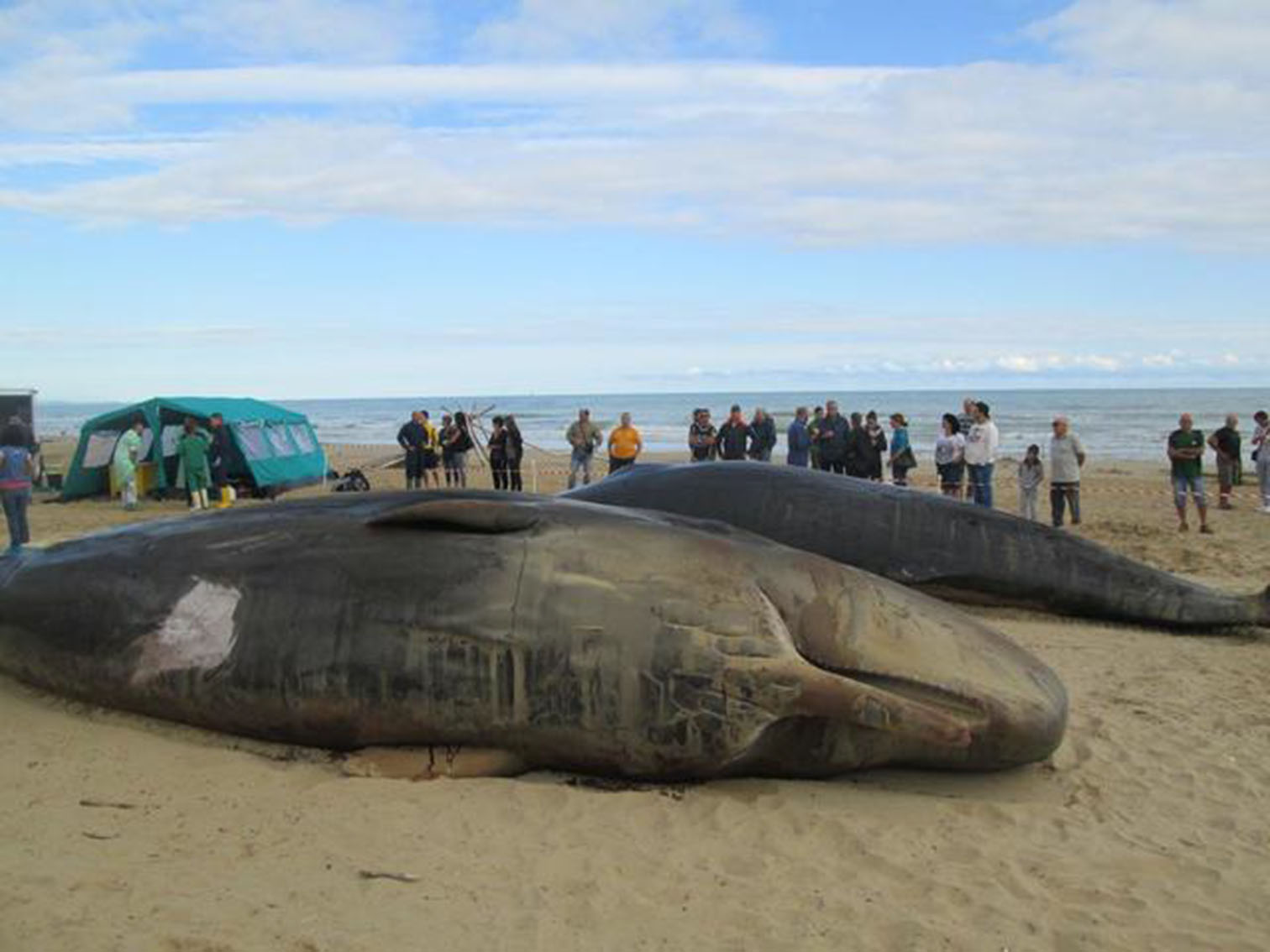
Figure 1. The image shows 2 dead female individuals from a group of 7 mass-stranded sperm whales (Physeter macrocephalus), which were found beached alive along the Central Adriatic Sea coast of Italy in September 2014. Three out of the 7 aforementioned whales, all of which females including a pregnant animal, did not survive the stranding, while the remaining 4 cetaceans were successfully refloated. All the 3 dead females, including the foetus carried by one of them, showed direct evidence of dolphin morbillivirus (DMV) infection (Mazzariol et al. 2017, 2018) (Image by Giovanni Di Guardo).
Should this journey back from sea to land, supposedly made by CeMV, worry us? And what implications, if any, could it exert on the feared RPV resurgence in cattle? In this respect, is there a concrete risk that rinderpest, the second infectious disease to be eradicated on Earth after smallpox (Tounkara and Nwankpa 2017), could re-emerge in cattle and should we pay attention, within such an undesirable albeit "speculative" scenario, to CeMV and its evolutionary dynamics?
Our answers to the above questions, based upon the socalled "principle of precaution", are affirmative.
As a matter of fact, a zoonotic potential has been recently documented for peste des petits ruminants virus (PPRV), another morbilliviral agent closely related to RPV, following a single amino acid change within its haemagglutinin (H) antigen (Abdullah et al. 2018). Still notably, CDV has been shown to successfully infect nonhuman primates under both natural and experimental conditions, while the same virus can also adapt to SLAM/CD150-expressing human cells following a single amino acid substitution in the H protein (Qiu et al. 2011; Sakai et al. 2013a, b).
In conclusion, we believe that further work is absolutely needed in order to better characterize the transmission barrier(s) between CeMV and different aquatic and terrestrial mammals, along with the virus- and the host-related factors underlying cross-species jumping within aquatic and terrestrial environments as well as at the level of the various water-land ecological interfaces.
HTML
-
The authors would like to thank the Journal's Editor and the two anonymous Reviewers for their highly valuable comments and suggestions, which have contributed to achieve a substantial improvement of the overall quality of this manuscript.
-
The authors declare that they have no conflict of interest.
-
This article does not contain any studies with human or animal subjects performed by any of the authors.

 DownLoad: