








HTML
-
Peste des petits ruminants virus (PPRV), a member of genus Morbillivirus in the family Paramyxoviridae (Amarasinghe et al. 2018), is the causative agent of peste des petits ruminants (PPR; Gibbs et al. 1979). PPR is a highly contagious disease of both domestic and wild small ruminants characterized by fever, pneumonia, diarrhea, and inflammation of the respiratory and digestive tracts (Obi et al. 1983; Aruni et al. 1998). Morbidity and mortality rates of the disease can reach up to 100% in susceptible animals, resulting in significant economic losses in endemic countries (Lefevre and Diallo 1990; Sen et al. 2010; Jones et al. 2016). PPRV genome is organized into eight genes in the order 3'-N-P/C/V-M-F-HN-L-5', which encode six structural proteins and two non-structural proteins (Diallo 1990; Bailey et al. 2005; Baron 2015). The PPRV genome is 15, 948 nucleotides (nts) long, which was considered the longest among morbilliviruses until the recent description of the novel Feline morbillivirus, whose genome was revealed to be 16, 050 nts long (Woo et al. 2012; Marcacci et al. 2016). Like other morbilliviruses, the PPRV genome respects hexamer length and the "rule of six" but has shown a certain degree of flexibility by adding one (+1) to two (+2) or removing one (-1) extra nucleotide in mutant minigenomes (Bailey et al. 2007). This unique feature of PPRV is different from other morbilliviruses that strictly obey the "rule of six, " such as the Nipah virus (Halpin et al. 2004). Recently, improvements in molecular techniques have contributed to the molecular understanding of the PPRV genome, although it is still in its infancy (Munir et al. 2013). Furthermore, based on the high homology of PPRV with other morbilliviruses, such as measles virus (MV), canine distemper virus (CDV), and rinderpest virus (RPV; Yoneda et al. 2004; de Vries et al. 2012; Nikolin et al. 2012), at the structural, genetic, and molecular level, much can be deduced about the life cycle of PPRV and its interaction with host cells (Munir et al. 2013); however, the factors that restrict the host range of susceptible animals remain to be investigated (Baron 2015; Baron et al. 2016).
The availability of complete genome sequences from vaccine strains and field isolates for all four lineages of PPRV (Bailey et al. 2005; Muniraju et al. 2013; Dundon et al. 2014) as well as the recent successful implementation of PPRV reverse genetics (Hu et al. 2012; Muniraju et al. 2015) are expected to further enhance our understanding of PPRV. Establishment of more stable reverse genetic systems for PPRV remains a critical tool for understanding the nature of the virus and virus/host interactions. This technique can help elucidate the life cycle of the virus, roles of host and non-host factors in viral replication, pathogenesis, and virulence. Furthermore, reverse genetics is also a powerful tool for developing differentiating infected from vaccinated animals (DIVA) vaccines and companion diagnostic tests that are still lacking for PPRV. The aim of this review is to discuss the current status of PPRV reverse genetics and to provide an extensive overview of recent innovations and advances in reverse genetics of other nonsegmented negative-sense RNA viruses. These advances may contribute to the improvement and/or development of reverse genetics techniques for PPRV.
-
In virology, reverse genetics simply refers to the generation of an infectious virus entirely from its complementary DNA (cDNA; Neumann and Kawaoka 2004). In contrast to traditional genetics (or forward genetics), which is based on observing the genetic basis of a phenotype or a trait, reverse genetics moves in an inverse way by analyzing the phenotypic results of specifically engineered genetic sequences (Peters et al. 2003; Hardy et al. 2010; Taniguchi and Komoto 2012). Following advances in molecular biology, reverse genetics was used in the mid-19th century to allow the first rescue of an infectious T2 bacteriophage (Fraser et al. 1957). This was then applied to DNA viruses as the DNA could be introduced directly into cells to generate an infectious virus (Pekosz et al. 1999; Armesto et al. 2012). Under the efforts of different researchers, reverse genetics moved to an important stage two decades later with the successful rescue of positive-sense RNA viruses—the bacteriophage Qbeta (Taniguchi et al. 1978) and the mammalian poliovirus (Racaniello and Baltimore 1981). Later, Boyer and Haenni (1994) discovered that in vitro transcription of RNA before transfection was more efficient, which was then applied to several RNA viruses. Although virus rescue was seen as a solution to understanding gene function and generating modified viruses to develop new vaccines and virus-based vectors, it was initially restricted to DNA and positive-sense RNA viruses for which in vitro synthesized genomic RNA is infectious when transfected to permissive cells (Conzelmann and Meyers 1996).
Negative-sense RNA viruses proved difficult for establishing reverse genetics because genomic RNA alone is not the biological entity for replication, transcription, and translation (Walpita and Flick 2005; Armesto et al. 2012). Furthermore, the naked RNA genome of a negative-sense RNA virus is not infectious and its natural state cannot be found in the cytoplasm. The genome is initially encapsidated by nucleoproteins, forming a ribonucleoprotein (RNP) complex where the antigenome is encapsidated by the positive (+)RNP and serves as a replicative intermediate functioning template for the generation of negative (-)RNP progeny. This is followed by interactions with matrix and viral glycoproteins to create the final budding of a new virion (Armesto et al. 2012; Lamb and Parks 2013). To overcome this problem, different approaches based on the rescue of negative-sense RNA viruses were developed by reconstituting the viral RNP complex. However, these approaches were only successful for segmented viruses such as influenza virus A (Luytjes et al. 1989). The idea of transfecting cells with cDNA encoding the antigenome, rather than the genome, has revolutionized the reverse genetics of non-segmented negative-sense RNA viruses, leading to the successful rescue of rhabdovirus rabies virus (RV; Schnell et al. 1994). However, this approach was not applicable to segmented viruses, which require co-transfection with constructs for each segment and involves modification of the single RNA (Luytjes et al. 1989; Enami et al. 1990). By co-transfecting with constructs for each of the segments, a segmented negative-sense RNA virus, the Bunyamwera bunyavirus was first rescued and was followed by influenza A viruses (Bridgen and Elliott 1996; Fodor et al. 1999; Neumann and Kawaoka 1999). However, rescue of double-stranded RNA viruses remained questionable as these viruses contain a genomic structure that does not naturally occur in cells. Nevertheless, a synthetic transcript of a double-stranded RNA virus was rescued and shown to be infectious (Mundt and Vakharia 1996).
Traditional reverse genetics for each category of viruses have been comprehensively reviewed elsewhere (Nagai 1999; Armesto et al. 2012; Pfaller et al. 2015). Likewise, the general applications of traditional reverse genetics of negative-sense RNA viruses have also been reviewed extensively (Radecke and Billeter 1997; Walpita and Flick 2005; Armesto et al. 2012; Pfaller et al. 2015). Therefore, our review will focus on recent innovations in the rescue of recombinant negative-sense RNA viruses that could be applicable to PPRV.
-
Recent advances in molecular biology have contributed to the understanding of PPRV pathobiology and molecular biology. However, there are several gaps that require establishment of stable reverse genetics for a thorough understanding of PPRV, which can contribute to the sustainable eradication of PPR. In addition to improving our current understanding of the nature of the virus, reverse genetics-based studies can accurately provide comprehensive molecular mechanisms of immune induction and can determine the viral proteins involved in immunosuppression during early infection with PPRV. Moreover, reverse genetics is an excellent tool for investigating interactions between viruses and cellular receptors. Using other techniques, it was revealed that short interfering RNA (siRNA)-mediated suppression of signaling lymphocytic activation molecule (SLAM) receptor lead to reduced PPRV titers (Pawar et al. 2008). Overexpression of ovine nectin-4 protein in epithelial cells permitted efficient replication of PPRV, confirming nectin-4 as a PPRV receptor (Birch et al. 2013; Fakri et al. 2016). However, it is believed that more receptors for PPRV exist and that reverse genetics techniques can help discover such new receptors. Furthermore, the availability of a stable reverse genetics system can support the development of DIVA vaccines and companion diagnostic tests that are important for the eradication process and post-eradication screening of the virus. Additionally, application of reverse genetics can lead to the establishment of a PPRV virus vector, as several studies have suggested that recombinant paramyxoviruses are genetically stable vectors due to their relatively simple reverse genetics systems (Walsh et al. 2000; Ge et al. 2011).
Unfortunately, PPRV reverse genetics is not well established. There have been many efforts to rescue PPRV and construct recombinant PPRV, which can be engineered, but the related literature remains insufficient and the main cause of failure is not fully or well documented. An early report in 2007 attempted to develop a reverse genetics system for PPRV but was unsuccessful (Bailey et al. 2007). Although this established system was only verified at the minigenome level, it was demonstrated that PPRV rescue elements include the antisense PPRV cDNA, PPRV genome promoter (GP), and PPRV antigenome promoter (AGP) flanked by hepatitis delta virus ribozyme (HDVRZ). In a comparison study of the PPRV heterologous and homologous helper plasmids with a previously established reverse genetics system for RPV, the PPRV homologous helper plasmids performed well in minigenome rescue, whereas expression in transfected cells indicated that PPRV did not strictly obey the "rule of six" in contrast with other paramyxoviruses (Bailey et al. 2007). Biological activity of the PPRV polymerase gene (L) was previously analyzed and the role of RNA-dependent RNA polymerase (RdRp) was determined in attempted reverse genetics involving the N, P, and L proteins as well as the PPRV leader and trailer for minigenome expression (Minet et al. 2009). Construction of the full-length cDNA clone was also reported in an attempted PPRV rescue assay (Zhai et al. 2010) with no evidence of virus rescue.
Despite the hypothesis that the high GC-rich region of the PPRV genome (between the open reading frame of M and F genes) is a potential bottleneck for viable PPRV rescue (Bailey et al. 2007), neither evidence of virus rescue nor a cause for failure was further reported or discussed. It was not until 2012 that a GFP-expressing recombinant PPRV was rescued from a PPRV full-length cDNA clone (Hu et al. 2012). The second and last known successful PPRV rescue was based on a commercially synthesized plasmid containing the full-length PPRV antigenome sequence with an inserted enhanced GFP (eGFP) sequence (Muniraju et al. 2015). In these two successful PPRV rescue systems, the rescued viruses were assessed for application in rapid virus neutralization tests (Hu et al. 2012) in comparison with the standard vaccine strain. A DIVA system assay with the rescued, positively marked recombinant virus through eGFP insertion and the negatively marked recombinant virus through mutation of the C77 monoclonal antibody binding epitope on the PPRV H gene was also assessed (Muniraju et al. 2015). Although these two available reverse genetics systems for PPRV can serve as good references, information regarding further application is still lacking. Therefore, there is still a need to establish or improve existing systems to efficiently understand the biology and pathogenicity of the virus and contribute to the planned PPRV eradication program.
-
PPRV belongs to the family Paramyxoviridae in the order Mononegavirales, which also includes Rhabdoviridae, Nyamaviridae, Bornaviridae, Filoviridae, and Pneumoviridae (Amarasinghe et al. 2018). These viruses share a common feature in reverse genetics—their RNA is not an infectious unit before they are packaged by nucleoproteins and transcribed by polymerase and other required co-factors. The history of successful reverse genetics for these virus families dates from the first rescue of an RV (Schnell et al. 1994). The possibility of virus engineering by nucleotide insertion or deletion at will has revolutionized our molecular understanding of these viruses. In the following sections we will present an overview of recent innovations in design and new strategies that can serve as references for improving or establishing PPRV reverse genetic systems.
-
The success of reverse genetics for non-segmented negative-sense RNA viruses is influenced by several factors, including the intact full-length cDNA of the virus to be rescued and its correct 5' and 3'-ends. T7 RNA polymerase activity tends to initiate from error-free templates at both 5' and 3'-ends of an RNA transcript. The so-called leader and trailer regions play a critical role in RNA transcription and virus replication (Yunus et al. 1999; Hanley et al. 2010) and thus these regions must be kept intact. In all reverse genetics systems analyzed thus far, mutations in both the leader and trailer sequences have shown a negative influence on RNA transcription and virus replication (Peeples and Collins 2000; Hanley et al. 2010). To avoid extraneous nucleotides from inserting in the 5' and 3'-ends of the RNA template during in vitro transcription, several methods have been described for yielding target RNAs with precise and defined ends (Pleiss et al. 1998; Helm et al. 1999; Kao et al. 1999; Avis et al. 2012). It is now believed that the possible heterologous 5' and 3'-ends during run-off transcription with T7 RNA polymerase can be controlled by self-cleaving trans and cis-acting ribozymes. Thus a hammerhead ribozyme (HHRZ) at the 5'-end and HDVRZ at the 3'-end have been introduced and are widely used with high efficiency (Been and Wickham 1997; Wichlacz et al. 2004; Avis et al. 2012; Szafraniec et al. 2012; Meyer and Masquida 2014). However, there is no common standard design applicable for all viruses and thus each system must be adapted and optimized for each particular virus. For example, insertion of HHRZ between the T7 promoter and start codon of the minigenome significantly improved rescue efficiency of the RV minigenome. This approach increased rescue efficiency by 100-fold for a full-length RV in combination with HDVRZ flanking the 3'-end of the antigenome (Ghanem et al. 2012). Surprisingly, the same approach showed poor performance with MV or Borna disease virus (BDV; Martin et al. 2006). Moreover, HHRZ sequences are obtained from different families of endonucleolytic ribozymes and may possess variations in cleavage efficiency among different sequences (Hammann et al. 2012).
With continued improvements in molecular biology, reverse genetics technology has progressed within the last two decades. In traditional reverse genetics, T7 RNA polymerase was widely used for negative-sense RNA viruses for which the majority of RNA transcription is accomplished in the cytoplasm (Edenborough and Marsh 2014). To improve the reverse genetics of these viruses, other alternative systems were developed, such as replacement of the T7 promoter by the human cytomegalovirus promoter (CMV), which is directly recognized by eukaryotic RNA polymerase (Inoue et al. 2003; Martin et al. 2006; Wang et al. 2015; Liu et al. 2017a). Following the same approach, Hu et al. (2012) developed a CMV promoter-based system and successfully rescued PPRV from full-length PPRV cDNA for the first time. In previous attempts, a similar approach was applied to improve RV recovery (Inoue et al. 2003). Although the T7 promoterbased system has been widely used to rescue negativesense RNA viruses, this system requires the use of an exogenous T7 RNA polymerase—usually from the vaccinia virus (vTF7-3)—which interferes with the viability of transfected cells (Nakatsu et al. 2006). This problem was overcome by adding vaccinia virus replication inhibitors, such as cytosine arabinoside and rifampicin, which increased the viability of transfected cells (Kato et al. 1996). Additionally, using mutant vaccinia virus (MVAT7) that grows in avian but not mammalian cells also avoided the vaccinia-induced cytotoxicity (Sutter et al. 1995; Wyatt et al. 1995). Efforts to develop helper virusfree systems with transgenic cell lines expressing T7 RNA polymerase have also been successful (Martin et al. 2006; Zheng et al. 2009; Li et al. 2011). Furthermore, the use of T7 RNA polymerase-expressing plasmids prior to or during co-transfection with the full-length antigenome and helper plasmids for generating infectious viruses has also been reported (Lowen et al. 2004; Witko et al. 2006; Freiberg et al. 2008; Jiang et al. 2009). Detailed information on the different systems used to rescue negative-sense RNA viruses in traditional reverse genetics have been extensively reviewed elsewhere (Radecke and Billeter 1997; Huemer et al. 2000; Edenborough and Marsh 2014).
There have been increasing reports of successful negative-sense RNA virus rescue using cellular inherent RNA polymerase Ⅰ (Pol Ⅰ) (Murakami et al. 2008; Suphaphiphat et al. 2010) and RNA polymerase Ⅱ (Pol Ⅱ)-driven systems under the control of a CMV promoter (Li et al. 2011; Wang et al. 2015). It was initially thought that the possibility of BDV rescue with RNA Pol Ⅰ and RNA Pol Ⅱ was due to its unique genetics and biological features of being the only member of Mononegavirales to exhibit nuclear replication (de la Torre 2002; Perez et al. 2003; Lipkin et al. 2011). A CMV promoter-driven RNA Pol Ⅱ system was first thought to function better with nuclear-replicating viruses; however, this hypothesis does not correlate with the recent rescue of other non-nuclear replicating viruses, such as PPRV and Newcastle disease virus (NDV), using the same promoter (Hu et al. 2012; Wang et al. 2015; Liu et al. 2017a). Other exceptions to this hypothesis include influenza viruses, MV, and Ebola virus. These cytoplasmic-based RNA transcription viruses have been rescued by cellular RNA Pol Ⅰ or RNA Pol Ⅱ (Edenborough and Marsh 2014). Despite these findings, further investigations are still needed on the utility of Pol Ⅱ for virus rescue of other negative-sense RNA viruses due to the possible splicing or polyadenylation of Pol Ⅱ transcripts (Martin et al. 2006).
The above examples leave room for hypothesizing alternative methods that can be explored for virus rescue of other non-nuclear transcription viruses including PPRV. Of note, the Pol Ⅰ and Pol Ⅱ-driven systems—under the control of a CMV promoter—can avoid helper virus-induced cytopathic effects (CPE) after cell transfection, which may be confused with the CPE induced by the rescued virus. Indeed, the CMV promoter was successfully used to rescue NDV, although it was shown to be less efficient in low virulent strains (Liu et al. 2017a). This low efficiency in rescuing low virulent strains was previously linked with system complexity involving several different-sized plasmids and the poor capacity of low virulent strains to be rescued, as described in the past for segmented influenza viruses (Neumann et al. 2005). In this regard, considering that all available methods for PPRV rescue employ the PPRV Nigeria75/1 strain (an attenuated vaccine strain) as template, we propose that a comparison of rescue efficiency of PPRV Nigeria75/1 strain with other virulent PPRV strains is necessary to assess possible limitations of virus rescue, which may be linked with low virulence of PPRV Nigeria75/1. However, due to biosecurity concerns, such comparative studies may require specialized laboratories that are licensed to handle live virulent PPRV.
-
The Paramyxoviridae family includes enveloped viruses with linear non-segmented negative-sense RNAs that are approximately 15.5 kb in length. Their active polymerase is usually a complex of at least two components and the initiation of the viral cycle is a complex of virion-associated RdRp that generates a functional RNP complex. Although molecular techniques such as PCR, gene cloning, and the use of endonuclease restriction enzymes have become routine, generation of an intact, error-free, and stable clone of more than 15 kb is not always easy. The PPRV genome (15, 948 nts) is one of the longest paramyxoviruses after the recently described novel Feline morbillivirus (16, 050 nts; Woo et al. 2012; Marcacci et al. 2016). Such large genome sizes are relatively difficult for generating error-free, fulllength cDNA using conventional cloning techniques. To overcome these potential sequence errors, a synthetic approach was applied to generate error-free cDNA in a PPRV rescue assay (Muniraju et al. 2015). However, this approach is not 100% error-free in cases where wild-type strains are to be rescued due to possible errors that may exist in the sequences available in GenBank. These limitations linked to genome size and the ability to generate stable fulllength cDNA plasmids were previously reported during an attempt at establishing a one plasmid-based system to rescue NDV. The 33 kb pMG-725/GFP-NPL plasmid was unstable due to its size and was lost during passaging in new bacterial culture medium (Liu et al. 2017b).
Alternative methods for generating long template cDNAs, such as the faster and more economic methods used in clone screening (Guo et al. 2007), should thus be considered. Recently, fast screening of the clones after transformation was shown to be more advantageous compared with conventional restriction and PCR methods (Liu et al. 2017b). Similar innovations in facilitating long DNA cloning, such as enzyme-free cloning and the recently modified enzyme-free cloning protocols, are continuously being developed (Tillett and Neilan 1999; Blanusa et al. 2010; Matsumoto and Itoh 2011). A new strategy for rapid generation of complete cDNA clones of negative-sense RNA and recombinant viruses (Nolden et al. 2016) is based on direct cloning of cDNA copies of a complete virus genome into reverse genetics vectors through a technique called "linear-to-linear RedE/T" recombination. This convenient technique has been long used to manipulate molecules such as yeast, bacteria, P1-derived artificial chromosome vectors, and Escherichia coli chromosomes (Zhang et al. 1998). Techniques associated with this method have been shown to be appropriate for direct cloning of long DNA sequences (Fu et al. 2012; Wang et al. 2016) and may constitute alternative methods of reducing the usual conflicts between restriction sites on plasmid vectors and gene inserts. In addition, these alternative methods reduce errors when compared with longterm manipulations of genome sequences under conventional techniques.
-
In virology, virus isolation is the core of any advancement in research. Isolation of a virus usually requires sensitive cells that allow viral growth and replication. Moreover, virus rescue from cDNA requires highly sensitive and permissive cell lines to allow effective replication and propagation of a rescued virus. In laboratory settings, several viruses of grazing animals, such as PPRV, sheep and goat pox virus (SPV), and Orf virus, usually exhibit poor growth in vitro and show difficulty adapting to commonly used cell lines or animal models (personal communication). Consequently, compared with other morbilliviruses, isolation of a field PPRV strain can be difficult due to the lack of sensitive cell lines or inadequate conditions of transportation and stocking of samples (Bhuiyan et al. 2014), especially in poor endemic countries. In this section, we will explore the available options for PPRV growth and replication in different cell lines to aid appropriate cell line choice for virus rescue assays.
Conventional cell lines that exhibit high performance in growth and propagation of PPRV are rarely available (Fakri et al. 2016). Fortunately, there is an increasing number of reports of engineered cell lines expressing known receptors such as SLAM and nectin-4 for other morbilliviruses that have been shown to be or may be more sensitive to supporting PPRV growth and replication (Hsu et al. 2001; Adombi et al. 2011; Muhlebach et al. 2011; Noyce and Richardson 2012; Noyce et al. 2013). In addition, a lymph node suspension cell line derived from cow showed higher sensitivity to PPRV in comparison with adherent Vero cells. The high titer of PPRV in the cowderived lymph node cell line was linked to the fact that lymphoid cells are major targets of different morbilliviruses (Mofrad et al. 2016). In a comparative study of potential permissive cell lines for PPRV growth and propagation, both BHK-21A and HEK 293T cells were able to produce PPRV titers (Silva et al. 2008). Research results have led to different opinions on the growth and replication of PPRV in various cell lines (Seki et al. 2003; Emikpe et al. 2009; Sannat et al. 2014; Muniraju et al. 2015; Fakri et al. 2016; Latif et al. 2018). Therefore, it is critical to select a highly sensitive cell line during PPRV rescue assay; engineered cell lines that exhibit high sensitivity for PPRV growth and replication are listed in Table 1.

Table 1. Samples of engineered sensitive cell lines for PPRV growth and replication.
(a) Initial RNA Transcription and Cleavage at the 5' and 3'-ends
(b) Generation of an Intact Full-length cDNA
(c) Cell Lines for Virus Rescue
-
Theoretically, co-transfection of antigenomic cDNA representing the full-length RNA of a non-segmented negativesense RNA virus with appropriate plasmids expressing RNP in the presence of a suitable source of T7 RNA polymerase will result in recovery of an infectious virus (Schnell et al. 1994; Armesto et al. 2012; Pfaller et al. 2015). In practice however, virus rescue is a complex process influenced by several factors including essential viral replication proteins and the functional viral RNA template. With that in mind, there is no standard protocol for reverse genetics even within the same family of viruses. In an effort to continually improve reverse genetics for PPRV, we will discuss below the recent and novel strategies used for rescue of other negative-sense RNA viruses, which may be successfully applied to PPRV.
In traditional reverse genetics of negative-sense RNA viruses (mostly with cytoplasmic RNA transcription), virus rescue relies on co-transfection into eukaryotic cells with at least four plasmids representing the full-length antigenomic sequence of the virus and helper plasmids (N, P, and L) independently cloned downstream of the T7 promoter in the presence of an exogenous T7 RNA polymerase source. Even though rescue efficiency for some viruses with cytoplasmic replication can be improved under the control of Pol Ⅰ and Pol Ⅱ, the T7 promoter is being gradually replaced by the CMV promoter, which is directly recognized by eukaryotic RNA polymerase (Inoue et al. 2003; Martin et al. 2006; Wang et al. 2015; Liu et al. 2017a). This replacement has the advantage of avoiding exogenous T7 RNA polymerase, which reduces system performance due to CPE caused by the helper virus or the increased number of co-transfected plasmids. On the other hand, the ability of codon-optimized T7 polymerase to drive paramyxovirus rescue was reported to be robust and has increased the efficiency of virus rescue for major paramyxoviruses (Beaty et al. 2017). In most traditional reverse genetics, HDVRZ was widely used downstream of the antigenome sequence to generate correct 3'-ends. However, an improved design with trans and cis-acting ribozymes (HHRZ and HDVRZ) flanking the antigenome upstream and downstream, respectively (as shown in Figs. 1A, 1B), has shown a more efficient performance. Thus, cDNA clones flanked by a combination of optimized 3' and 5'-ribozymes upstream and downstream to generate the exact 3' and 5'-ends increased RV rescue by at least 100-fold (Ghanem et al. 2012). Furthermore, a reduced number of plasmids co-transfected during virus rescue increased rescue efficiency in segmented viruses (Neumann et al. 2005; Zhang and Curtiss 2015), double-stranded RNA viruses (Kobayashi et al. 2010), and Nipah virus (Yun et al. 2015). Another important aspect to consider in reverse genetics is the design of appropriate transcription termination elements, which are still a point of discussion in molecular biology (Richard and Manley 2009; Porrua and Libri 2015).
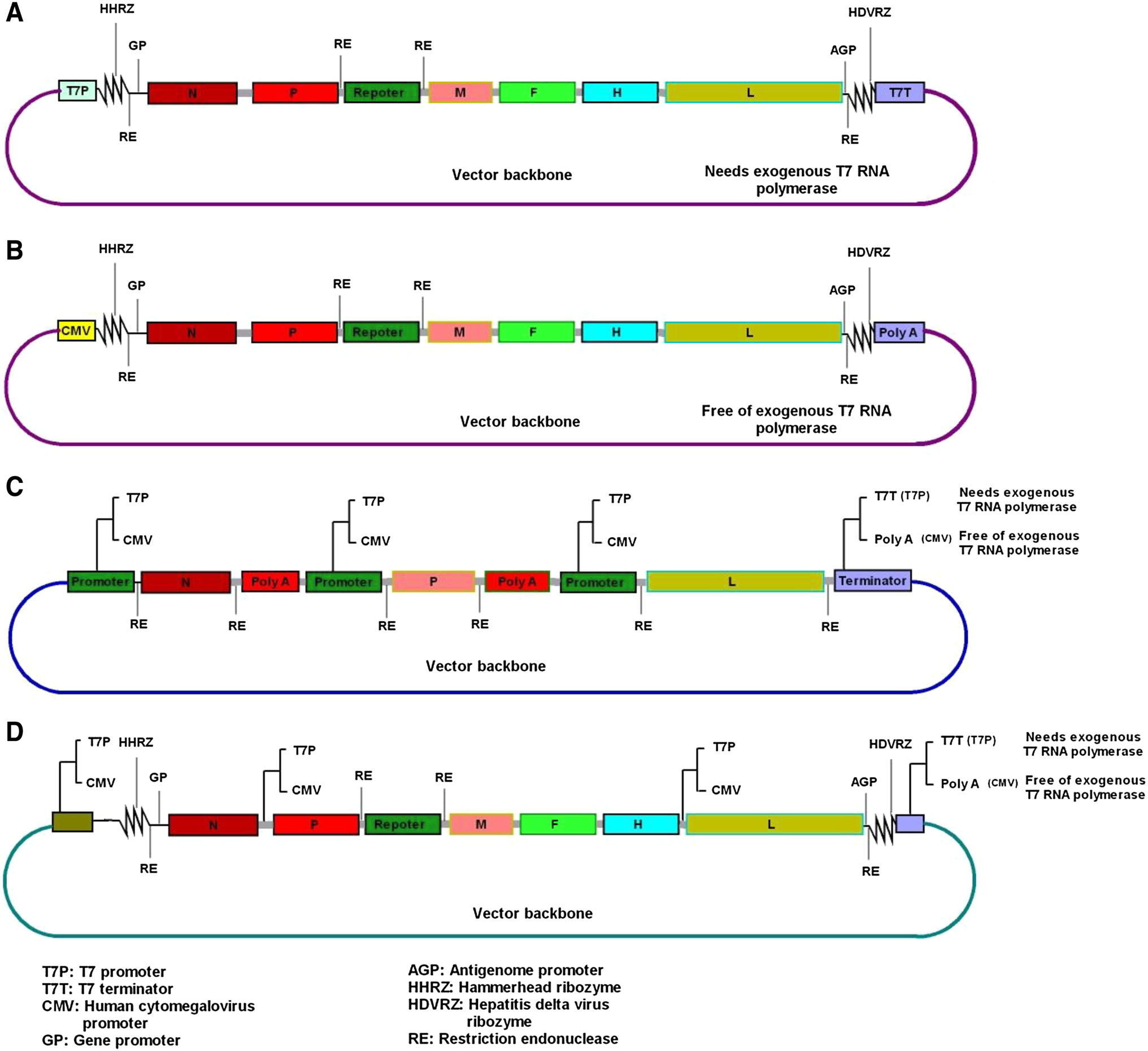
Figure 1. Summary illustrating the recent innovations in experimental design of rescuing recombinant non-segmented negative-sense RNA viruses. A, B Design of the full-length cDNA antigenome flanked by trans and cis-acting ribozymes to generate the correct 5' and 3'-ends in T7 and CMV promoter-driven systems for initial RNA transcription. The strategy in A requires exogenous T7 RNA polymerase while B is free of exogenous T7 RNA polymerase and relies on the CMV promoter. C The two-plasmid system design with a single helper plasmid encoding three translational cassettes of the essential viral replication proteins (N, P, and L). Each translational cassette is spanned with an appropriate promoter (T7 or CMV) and terminator (T7T or poly-A tail) that are dependent on the rescue strategy and with or without exogenous T7 RNA polymerase. In this system, only the plasmid containing the full-length antigenome and the single helper plasmids will be co-transfected to generate an infectious virus. D The design of the one plasmid and helper plasmid free basedsystem that implements both T7 and CMV promoter-driven systems with or without exogenous T7 RNA polymerase. In this system, additional promoter (T7 or CMV) sequences are inserted by careful substitution into the viral cDNA at strategic positions. This allows transcription of sub-genomic RNAs that encode essential viral replication proteins (N, P, and L) that are needed for the RNP complex to form. The T7 promoter-based system requires an exogenous T7 RNA polymerase and the CMV promoter-based system is free of exogenous T7 RNA polymerase.
In view of the abovementioned points, we will further discuss design and rescue strategies that could be applied to improve existing systems or develop new reverse genetics systems for PPRV (Figs. 1C, 1D). These designs are either T7 or CMV promoter-driven systems depending on the facilities available in the laboratory.
-
The two-plasmid system is a new approach consisting of a single helper plasmid encoding three translational cassettes of essential viral replication proteins (N, P, and L) cloned into one plasmid vector as illustrated in Fig. 1C, which was previously described by Liu et al.(2017a, b). In this system, each translational cassette is spanned with an appropriate promoter (T7 or CMV) and terminator (T7T or polyA tail) and—depending on the rescue strategy—with or without exogenous T7 RNA polymerase. In this system, only a plasmid containing the full-length antigenome of the virus and a single helper plasmid will be co-transfected into a eukaryotic cell to generate an infectious virus. Compared with the traditional four-plasmid system, the two-plasmid system exhibited a 100% rescue efficiency against the 67% seen for the four-plasmid system and had higher (4.5-fold) NDV virus titers. Moreover, the two-plasmid system was found more efficient in the rescue of lentogenic viruses and can rescue viruses that were not possible by the fourplasmid system (Liu et al. 2017a, b).
-
The single-plasmid system is a helper plasmid-free-based system that may be driven by a T7 or CMV promoter with or without exogenous T7 RNA polymerase (Fig. 1D). In this system, additional promoter (T7 or CMV) sequences are inserted by careful substitution in the viral cDNA at strategic positions. This allows independent transcription of sub-genomic RNAs encoding essential viral replication proteins (N, P, and L) that allow the RNP complex to form. Although this technique showed less efficiency in virus replication compared with that of the parental virus, it could rescue NDV by using a single full-length viral cDNA plasmid that included T7 promoter sequences at strategic positions (Peeters and de Leeuw 2017). Due to similarities in replication strategies, the single-plasmid system is predicted to be applicable to most non-segmented negativesense RNA viruses. Theoretically, it may work with or without exogenous T7 RNA polymerase, depending on the promoter (T7 or CMV) that triggers the initial RNA transcription. Not only has this method worked for NDV, but it also showed the advantages of having a reduced size with promoter sequences inserted by sequence substitution into the intergenic untranslated regions (UTRs) of sub-genomic RNAs encoding essential viral replication proteins. However, it is critical to carefully select the substitution region to avoid disturbing essential elements that enhance the expression of downstream genes in the viral genome. Previously, a similar approach was assayed by the construction of a single plasmid that included four translational cassettes representing the full-length sequence of the NDV and the three helper plasmids representing the NDV N, P, and L proteins (Liu et al. 2017a). However, this construct was unsuccessful, and the author suspected the large size (33 kb) of the plasmid as the reason for failure.
(a) Two-Plasmid-Based System
(b) Single-Plasmid-Based System
-
Years after the approval of a global strategy for the control and eradication of PPRV, there are still continued reports of new PPRV cases, even in unusual hosts, worldwide (Boussini et al. 2016; Marashi et al. 2017; Shatar et al. 2017). Until now, research on several areas of basic and applied virology is still lacking, particularly, with respect to the mechanisms of disease transmission, epidemiology, virus life cycle, and the role of wildlife reservoirs in disease persistence and propagation, which are not yet well defined (Baron et al. 2016, 2017). In addition, the pathobiology and molecular biology of PPRV are still not fully understood (Baron 2015; Munir 2015). The next generation of vaccines and diagnostic tests including DIVA systems are also lacking (Munir et al. 2013; Baron et al. 2017). In this review, we discussed the recent advances in reverse genetics technology of non-segmented negative-sense RNA viruses that may be applicable to PPRV. We also proposed several designs that may improve existing strategies or promote the development of new reverse genetic techniques for PPRV. Reverse genetics is a powerful tool that may provide solutions to understanding this economically important pathogen, supporting the ongoing efforts of PPRV sustainable control and eradication.
-
This work was supported by the National Key Research and Development Program of China (2016YFD0500108 and 2016YFE0204100) and the International Cooperation Project of CAAS Innovation Program (CAAS-GJHZ201700X). We thank Dr Yuen Zhang from UCL Whittington hospital UK for his help with editorial assistance.
-
The authors declare that they have no conflict of interest.
-
The authors declare that they have no conflict of interest. This article does not contain any studies with human or animal subjects performed by any of the authors.
-
This article is distributed under the terms of the Creative Commons Attribution 4.0 International License (http://creativecommons.org/licenses/by/4.0/), which permits unrestricted use, distribution, and reproduction in any medium, provided you give appropriate credit to the original author(s) and the source, provide a link to the Creative Commons license, and indicate if changes were made. The Creative Commons Public Domain Dedication waiver (http://creativecommons.org/publicdomain/zero/1.0/) applies to the data made available in this article, unless otherwise stated.

 DownLoad: