







-
Rabies is an acute viral infection and causes encephalitis which affects most warm blooded animals including man. It is caused by a single stranded RNA virus of the genus Lyssavirus and family Rhabdoviridae. It is still a major public health problem in most developing countries including India where an estimated 20 000 human deaths and 17 million animal bites are reported every year[9]. The main vector of rabies in India is dog in over 95 % of human cases but other animals like cats, monkeys, mongooses and wild animals also transmit the disease. Though rabies is almost 100 % fatal, it is also successfully preventable if the currently recommended state of the art prophylactic measures are instituted soon after the exposure[11]. Prior confirmation of the rabid status of the biting animal can guide the physician to start or withhold the post exposure treatment as the presently available vaccines and immunoglobulin's are quite expensive and often in short supply. The presently recommended gold standard technique for post mortem diagnosis of rabies is the direct immunofluorescence assay (dFA)[1]. The performance of this technique is presently restricted to 2-3 laboratories in India as it requires an expensive fluorescence microscope, a specific rabies conjugate as well as technical expertise. Thus there is a need for a rapid diagnostic technique that can be adapted to field conditions, is economical for the resource constraint countries but is also as sensitive and specific as dFA. Recently the Centers for Disease Control (CDC) Atlanta, has developed a simple and raid technique for rabies diagnosis which is based on the principle of immunohistochemistry where the rabies virus nucleoprotein (N) antigen in the suspect brain smear is captured by a cocktail of biotinylated anti-N monoclonal antibody and subsequent color development. This technique, which is known as the direct rapid immunohistochemical test (dRIT), has been found to be as specific and sensitive as the gold standard dFA and has undergone limited field trials in Africa, China, Afghanistan and Iraq[2, 3, 8, 10]. Based on the results of these trials, the South-East Asia Regional Office (SEARO) of the WHO wanted to assess the utility of this test in other Asian countries, particularly the Indian subcontinent where rabies is highly endemic. Thus, the department of Neurovirology at the National Institute of Mental Health and Neurosciences (NIMHANS), Bangalore, India, which is also a WHO collaborating centre for reference and research on rabies, was supplied with reagents and technical input from CDC, Atlanta, USA. Subsequently, the department successfully established the test procedure and has evaluated this test in comparison to dFA using a number of animal brains from different species as well as some human brains. In this report we communicate our results which clearly establish that this new test dRIT is as sensitive and specific as dFA and has the potential to replace the dFA in resource constrained developing countries.
HTML
-
We tested 400 brain samples over a period of 2 years from August 2009 to January 2012. The animal brain samples were those that were sent to the laboratory for confirmation of rabies from different parts of Karnataka and Kerala (two states in southern part of India). Among these sample, 320 brains were from suspect rabid dogs, 10 from cats, 30 from cattle, and 2 from wild foxes which had bitten several people in the northern part of Karnataka. Most of the brains were sent to us by preserving in 50 % glycerol-saline. Five fresh dog brains were available as the extraction of brain from these dogs was done in our department. We also tested 38 human brains which were taken from the human brain repository at the NIMHANS. These brains were from cases of suspected paralytic rabies admitted to the neurological services of NIMHANS during the period 1998-2008. The brain samples, which were preserved in glycerol saline, were taken from the cerebral cortex. Therefore, for comparative purposes we also took a piece of the cerebral cortex from fresh dog brains and human brains.
-
This was performed as per the WHO recommended procedure[1]. Briefly, smears were made from brain samples after washing them thoroughly with normal saline. The smears were air dried for 5 min and fixed in cold acetone for 2 h. They were then stained with a 1:40 dilution of anti-rabies virus nucleoprotein polyclonal FITC antibody (Chemicon USA, Cat No. F 5009) for 30 min and observed under an inverted fluorescence microscope (Nikon, Eclipse) using a 40× objective. Positive and negative smears made from infected and normal mouse brains were used as controls. Brain smears showing green fluorescent particles of varying size within or outside neurons were considered positive. The slides were independently evaluated by 2 experienced technicians.
-
Touch impressions were made on labeled glass microscope slides. The slides were air-dried, fixed in 10 % buffered formalin for 10 min, dip-rinsed in wash buffer phosphate buffered saline with 1 % Tween 80 (TPBS), immersed in 3 % hydrogen peroxide for 10 min, and dip-rinsed in fresh TPBS. After dipping, the excess buffer was shaken from the slides and blotted from the edges surrounding the impression. This treatment was repeated after each rinsing step. The slides were incubated in a humidity chamber (a cover on a moistened paper towel on an even surface) with the monoclonal antibody cocktail for 10 min, dip-rinsed in TPBS, incubated with streptavidin-peroxidase complex (Kierkegaard and Perry Laboratories, Inc., USA) for 10 minutes and dipped in TPBS. A 3-amino-9-ethylcarbazole (AEC) stock solution was prepared by dissolving one 20 mg tablet AEC (Sigma-Aldrich Corp, St Louis, MO, USA) in 4 mL N, N-dimethyl-formamide (Fisher Scientific International, Inc., USA) and stored at 4 ℃. A working dilution was prepared by adding 1 mL AEC stock solution to 14 mL 0.1 mol/L acetate buffers (Polyscientific, USA) and 0.15 mL 3% hydrogen peroxide. The slides were incubated with the AEC peroxidase substrate for 10 min and dip-rinsed in distilled water. They were then counterstained with Gill's formulation #2 hematoxylin (Fisher Scientific International) diluted 1:2 with distilled water for 2 min and dip-rinsed in distilled water. Finally, they were mounted with a water-soluble mounting medium (BioMeda Corp., USA) and examined by light microscopy (Leica Microsystems AG, Germany) using a 20× objective to scan the field and a 40× objective for higher power inspection. Rabies virus nucleoprotein antigen appears as red inclusions against a blue background. Two different technicians who had not interpreted the dFA slides interpreted the dRIT slides.
Brain samples
Direct immune fluorescence assay (dFA) Test
Direct Rapid Immunohistochemistry Test (dRIT)
-
Before studying the test slides, positive and negative controls stained by the two techniques were examined using appropriate microscopes. In the dFA test, normal mouse brain smears did not show any fluorescence and in the dRIT, only a background light blue colour was observed (Fig. 1). In the dFA test, the positive smears showed bright green fluorescence particles of varying size either scattered or within the neurons. In the dRIT, positive brains showed dark red particles scattered all over the field or within the neurons (Fig. 1). The comparative results of the two tests in a positive brain smear are shown in Fig. 2. The brains of the animals which were positive by dFA were also positive by dRIT and the negative brains were negative by both the tests. Thus there was 100 % concordance between the two tests. Interestingly 3 dog brains which were faintly positive by dFA were very strongly positive by dRIT. Generally it was easier to interpret a smear stained by dRIT than by dFA. In case of fresh brains, the ease of interpretation was similar with both the tests but with brains preserved in 50 % glycerol saline, interpretation was much easier with the dRIT technique. The results of different brain samples tested by the two techniques is depicted in Table 1.

Table 1. Correlation between direct rapid immunohistochemistry test (dRIT) and direct Fluorescent antibody assay (dFA)
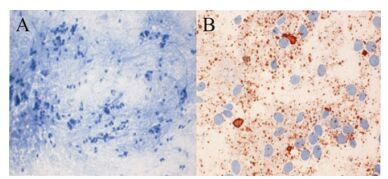
Figure 1. Comparison of Negative and Positive control brain smears by Direct Rapid Immunohistochemical test (dRIT). Note: the presence of numerous reddish brown particles representing rabies virus N antigen (B) compared to none (A).
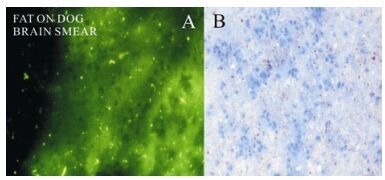
Figure 2. Comparison of direct Fluorescent antibody assay (dFA) and direct rapid Immunohistochemical test (dRIT) in a positive dog brain smear. Note: the presence of green fluorescent particles with dFA (A) and reddish brown particles with dRIT(B).
-
Rabies is endemic in all parts of India except the islands of Andaman, Nicobar and Lakshadweep. Recently, a scientific estimate on the incidence of human rabies was obtained but accurate data on the incidence of animal rabies is still not available. Stray dogs are the major reservoir of the virus and an estimated 25 million stray dogs are present in the country[4]. There is no comprehensive national rabies control programme operational in India but in some major cities, under the aegis of animal birth control programme (ABC), dog sterilization and vaccination have been performed for the last decade. However, we really cannot assess the impact of this programme as we do not have a systematic rabies surveillance, mainly due to lack of diagnostic facilities in most parts of the country. Some laboratories attached to veterinary colleges and research institutions perform the Seller's technique for demonstration of Negri bodies which is not very sensitive and specific. False positive and false negative results are not uncommon with this technique. Only a handful of laboratories in India are performing dFA.
The direct immune-fluorescence assay (dFA) Test (dFA) developed by Goldwasser and Kissling in 1957, continues to be the "Gold standard" for rabies diagnosis all over the world. Earlier, techniques such as rapid rabies enzyme immunodiagnosis (RREID) were developed based on the principle of ELISA[6]. Though RREID was found to be as sensitive and specific as dFA, applicability in field conditions was a problem and the test was not used widely despite its simplicity both in procedure and interpretation. The recently developed technique dRIT by CDC, Atlanta appears to be a cost effective alternative to the relatively expensive FAT. The principle of dRIT and preliminary evaluation has been described earlier. The dRIT is based on capture of rabies virus N antigen by biotinylated anti-nucleocapsid monoclonal antibodies and color development by streptavdin-peroxidase and coloring reagent aminoethyl carbazole (AEC). The aggregates of rabies virus N protein visualized under a light microscope appear as dark red to brown colored bodies within or outside neurons. Counter staining with hematoxylin gives a light blue background which enhances the visibility of red colored bodies (Fig. 1 and 3).
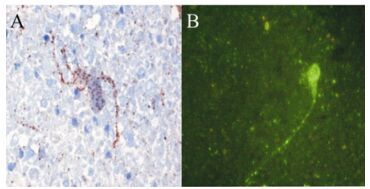
Figure 3. A positive human brain smear stained by dRIT (A) and dFA (B). Note: the presence of reddish brown particles(A) and green fluorescent particles(B) with in neuron.
As of today, dRIT has been evaluated in Tanzania and Chad in Africa[3]. In Asia, this test has been successfully evaluated in China[10] and in Afghanistan and Iraq[8]. This is the first time this test has been evaluated in India, a country where the burden of animal and human rabies is the highest. Four hundred brains were tested by dRIT in parallel with FAT dFA. Most of the brains tested in this study were preserved in 50 % glycerol-saline. The twenty three human brains tested were frozen and we could test 5 fresh canine brains which were brought to our laboratory from the city of Bangalore. The procedure of dRIT is quite simple though the number of steps involved is more than FAT dFA. The fixation for 10 min in formalin inactivates the virus without affecting the antigenicity.
The use of biotinylated cocktail monoclonal antibodies to N protein assures an extreme degree of specificity. There was 100% reagent used for dFA was polyclonal and the capturing antibody correlation between dFA and dRIT despite the fact that the FITC used in dRIT was monoclonal. This could be attributed the fact that the Mab supplied by the CDC is a cocktail of three Mab's to 3 different antigenic sites of N protein and has the capacity to react with all the virus strains of genotype I. Recently, some studies in India have reported the molecular epidemiology of rabies virus strains prevalent in different parts of India based on N gene sequencing and all strains tested so far have belonged to genotype I[5, 7]. As expected, the glycerin preserved specimens were comparatively less reactive than the fresh dog brains. This also correlated with the distribution of fluorescent foci as observed in FAT dFA. One of the main advantages of this test was the relative ease for reading and interpreting the results using a ordinary light microscope, requiring less than two to three minutes, in comparison to the expertise and time consumed to read and interpret the results of dFA using a fluorescence microscope. Our evaluation of dRIT is purely in comparison to FAT dFA. It may be desirable to evaluate this technique with more confirmatory tests such as virus isolation in mice or neuro 2A cells.
There are several facts to be considered before advocating routine use of dRIT in developing countries. Firstly, the test needs to be evaluated in other Asian countries to obtain reproducibility. There is a need to assure constant and uninterrupted supply of reagents as the basic reagent (anti-N Monoclonal antibodies) is presently available from CDC, Atlanta alone. Second, the feasibility of producing reagents in select reference laboratories need to be considered or even better, commercialization of the production of a dRIT kit.
To conclude, dRIT appears to be a promising upcoming rapid diagnostic test which has the potential to serve as an alternative to the dFA, and may be useful for resource constraint developing countries of Asia where rabies is still a major public health problem. Another added advantage of this technique is the easy applicability in the field conditions and rapid diagnosis of the biting animal, and if found negative it will avoid use of highly expensive rabies vaccines and immunoglobulin's. The test will also be useful for cost-effective surveillance of rabies in countries where it is still endemic.


 DownLoad: