. doi: 10.1016/j.virs.2026.07.002
Citation: Xingyu Yan, Zeyu Liu, Kexin Liu, Zhenlin Yang, Jianxing Wang, Chao Zhang. The C-terminal T234 residue of VP3 is required for KREMEN1 receptor-dependent infectivity and pathogenesis of coxsackieviruses A10 and A8 .VIROLOGICA SINICA, 2026, 41(4) : 882-897.  http://dx.doi.org/10.1016/j.virs.2026.07.002

VP3蛋白C端T234残基是柯萨奇病毒A10和A8通过KREMEN1受体依赖方式实现感染性及致病性所必需的关键位点

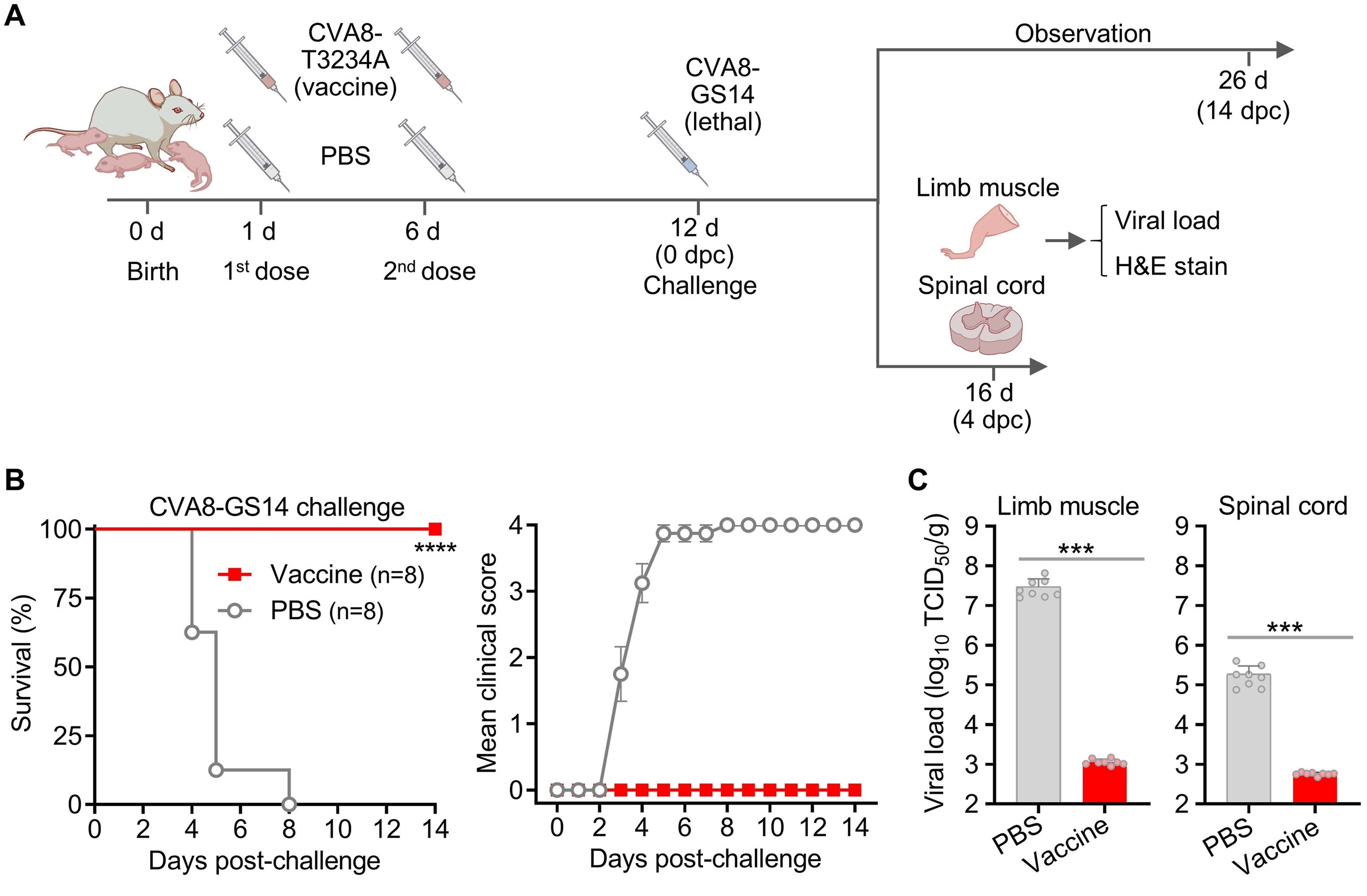
  • 柯萨奇病毒A10(CVA10)是手足口病的主要病原体之一,利用KREMEN1(KRM1)作为其细胞受体。虽然前期的研究确定了VP2残基K140是KRM1依赖性肠道病毒与KRM1结合的通用锚点,但其他受体界面残基的功能意义尚不清楚。本研究通过结构导向的定点突变,发现VP3蛋白C端完全保守的T234残基是CVA10感染所必需的。T234A突变不影响病毒颗粒组装,但完全消除了与KRM1结合和细胞吸附。有趣的是,这种需求表现出显著的病毒特异性:同源残基对CVA8至关重要,但对其他利用KRM1的肠道病毒(包括CVA2–CVA6和CVA12)并非必需。T234A突变显著减弱了CVA10和CVA8在新生小鼠中的致病性。此外,CVA8-T234A突变株作为减毒疫苗,能够完全保护新生小鼠免受致死剂量CVA8的攻毒。我们的发现建立了一个模型:KRM1结合依赖保守的VP2-K140锚点以及病毒特异性次级残基,其中VP3-T234是CVA10和CVA8的关键决定位点。这些见解加深了我们对肠道病毒-受体相互作用的理解,并为疫苗开发提供了新方向。

The C-terminal T234 residue of VP3 is required for KREMEN1 receptor-dependent infectivity and pathogenesis of coxsackieviruses A10 and A8

  • Corresponding author: Chao Zhang, chao_zhang@fudan.edu.cn
  • Received Date: 20 May 2026
    Accepted Date: 06 July 2026
  • Coxsackievirus A10 (CVA10) is a major causative agent of hand, foot and mouth disease and utilizes KREMEN1 (KRM1) as its cellular receptor. While our previous work identifies VP2 residue K140 as a universal anchor for KRM1 binding among KRM1-utilizing enteroviruses, the functional significance of other receptor-interface residues remains poorly characterized. Here, through structure-guided mutagenesis, we demonstrate that VP3-T234, a completely conserved residue at the C-terminus of VP3, is essential for CVA10 infectivity. The T234A mutation does not affect virion assembly but abolishes both KRM1 binding and cellular attachment. Interestingly, this requirement shows remarkable virus specificity: the homologous residue is critical for CVA8, but is not required for other KRM1-utilizing enteroviruses including CVA2-CVA6 and CVA12. The T234A mutation significantly attenuates the pathogenesis of both CVA10 and CVA8 in neonatal mice. Moreover, the CVA8-T234A mutant provides complete protection as an attenuated vaccine against lethal CVA8 challenge. Our findings establish a model wherein KRM1 engagement relies on the conserved VP2-K140 anchor complemented by virus-specific secondary residues, with VP3-T234 representing a key determinant for CVA10 and CVA8. These insights advance our understanding of enterovirus-receptor interactions and provide new directions for vaccine development.

  • 加载中
    1. Cui, Y., Peng, R., Song, H., Tong, Z., Qu, X., Liu, S., Zhao, X., Chai, Y., Wang, P., Gao, G.F., Qi, J., 2020. Molecular basis of Coxsackievirus A10 entry using the two-in-one attachment and uncoating receptor KRM1. Proc Natl Acad Sci U S A, 117, 18711-18718.

    2. Dai, W., Xiong, P., Zhang, X., Liu, Z., Chen, J., Zhou, Y., Ye, X., Zhang, C., 2019. Recombinant virus-like particle presenting a newly identified coxsackievirus A10 neutralization epitope induces protective immunity in mice. Antiviral Res, 164, 139-146.

    3. Fu, X., Wan, Z., Li, Y., Hu, Y., Jin, X., Zhang, C., 2020. National Epidemiology and Evolutionary History of Four Hand, Foot and Mouth Disease-Related Enteroviruses in China from 2008 to 2016. Virol Sin, 35, 21-33.

    4. Howley, P.M., Knipe, D.M., Whelan, S., Freed, E.O., 2022. Fields virology: RNA viruses, Lippincott Williams & Wilkins.

    5. Ji, W., Qin, L., Tao, L., Zhu, P., Liang, R., Zhou, G., Chen, S., Zhang, W., Yang, H., Duan, G., Jin, Y., 2021. Neonatal Murine Model of Coxsackievirus A2 Infection for the Evaluation of Antiviral Therapeutics and Vaccination. Front Microbiol, 12, 658093.

    6. Ke, X., Li, X., Liu, Z., Liu, K., Liu, W., Yan, X., Shu, B., Zhang, C., 2025. Molecular mechanisms of receptor recognition and antibody neutralization of coxsackievirus A6. Nat Commun, 17, 934.

    7. Li, X., Liu, Z., Yan, X., Tian, Y., Liu, K., Zhao, Y., Shao, J., Hao, P., Zhang, C., 2023. VP2 residue N142 of coxsackievirus A10 is critical for the interaction with KREMEN1 receptor and neutralizing antibodies and the pathogenicity in mice. PLoS Pathog, 19, e1011662.

    8. Liu, Z., Li, X., Li, X., Yan, X., Tian, Y., Zhao, Y., Liu, K., Hao, P., Zhang, S., Zhang, C., 2025. Completely conserved VP2 residue K140 of KREMEN1-dependent enteroviruses is critical for virus-receptor interactions and viral infection. mBio, 16, e0304024.

    9. Pettersen, E.F., Goddard, T.D., Huang, C.C., Couch, G.S., Greenblatt, D.M., Meng, E.C., Ferrin, T.E., 2004. UCSF Chimera--a visualization system for exploratory research and analysis. J Comput Chem, 25, 1605-1612.

    10. Song, Y., Wang, D., Zhang, Y., Han, Z., Xiao, J., Lu, H., Yan, D., Ji, T., Yang, Q., Zhu, S., Xu, W., 2020. Genetic Diversity Analysis of Coxsackievirus A8 Circulating in China and Worldwide Reveals a Highly Divergent Genotype. Viruses, 12, 10, 1061.

    11. Staring, J., Van Den Hengel, L.G., Raaben, M., Blomen, V.A., Carette, J.E., Brummelkamp, T.R., 2018. KREMEN1 Is a Host Entry Receptor for a Major Group of Enteroviruses. Cell Host Microbe, 23, 636-643, e635.

    12. Yang, L., Cai, T., Wang, X., Ge, Q., Lv, L., Xiao, D., Zeng, Y., Ma, X., Zhou, X., Zhang, Y., Liu, N., Yan, D., Zhu, S., Yang, Q., Xiao, J., Sun, Q., Zhou, L., Xiao, M., Ji, T., 2025. Multiple Transmission Pathways of Coxsackievirus A10 Leading to its Global Spread: A Phylogenetic and Spatiotemporal Analysis Based on Virological Surveillance. J Med Virol, 97, e70416.

    13. Yang, L., Li, S., Liu, Y., Hou, W., Lin, Q., Zhao, H., Xu, L., He, D., Ye, X., Zhu, H., Cheng, T., Xia, N., 2015. Construction and characterization of an infectious clone of coxsackievirus A6 that showed high virulence in neonatal mice. Virus Res, 210, 165-168.

    14. Zhang, C., Liu, C., Shi, J., Wang, Y., Xu, C., Ye, X., Liu, Q., Li, X., Qiao, W., Yin, Y., Cong, Y., Huang, Z., 2022. Molecular mechanism of antibody neutralization of coxsackievirus A16. Nat Commun, 13, 7854.

    15. Zhang, C., Xu, C., Dai, W., Wang, Y., Liu, Z., Zhang, X., Wang, X., Wang, H., Gong, S., Cong, Y., Huang, Z., 2021. Functional and structural characterization of a two-MAb cocktail for delayed treatment of enterovirus D68 infections. Nat Commun, 12, 2904.

    16. Zhang, C., Zhang, X., Zhang, W., Dai, W., Xie, J., Ye, L., Wang, H., Chen, H., Liu, Q., Gong, S., Geng, L., Huang, Z., 2018. Enterovirus D68 virus-like particles expressed in Pichia pastoris potently induce neutralizing antibody responses and confer protection against lethal viral infection in mice. Emerg Microbes Infect, 7, 3.

    17. Zhao, Y., Zhou, D., Ni, T., Karia, D., Kotecha, A., Wang, X., Rao, Z., Jones, E.Y., Fry, E.E., Ren, J., Stuart, D.I., 2020. Hand-foot-and-mouth disease virus receptor KREMEN1 binds the canyon of Coxsackie Virus A10. Nat Commun, 11, 38.

    18. Zhou, Y., Van Tan, L., Luo, K., Liao, Q., Wang, L., Qiu, Q., Zou, G., Liu, P., Anh, N.T., Hong, N.T.T., He, M., Wei, X., Yu, S., Lam, T.T., Cui, J., Van Doorn, H.R., Yu, H., 2021. Genetic Variation of Multiple Serotypes of Enteroviruses Associated with Hand, Foot and Mouth Disease in Southern China. Virol Sin, 36, 61-74.

  • 加载中
  • 10.1016j.virs.2026.07.002-ESM.docx

Figures(1)

Article Metrics

Article views(336) PDF downloads(0) Cited by(0)

Related
Proportional views
    通讯作者: 陈斌, bchen63@163.com
    • 1. 

      沈阳化工大学材料科学与工程学院 沈阳 110142

    1. 本站搜索
    2. 百度学术搜索
    3. 万方数据库搜索
    4. CNKI搜索

    The C-terminal T234 residue of VP3 is required for KREMEN1 receptor-dependent infectivity and pathogenesis of coxsackieviruses A10 and A8

      Corresponding author: Chao Zhang, chao_zhang@fudan.edu.cn
    • a. Shanghai Institute of Infectious Disease and Biosecurity, Fudan University, Shanghai 200032, China;
    • b. Shanghai Key Laboratory of Lung Inflammation and Injury, Department of Pulmonary Medicine, Zhongshan Hospital, Fudan University, Shanghai 200032, China;
    • c. Shanghai Engineering Research Center for Synthetic Immunology, Shanghai 200032, China;
    • d. Shandong Center for Disease Control and Prevention, Jinan 250014, China

    Abstract: Coxsackievirus A10 (CVA10) is a major causative agent of hand, foot and mouth disease and utilizes KREMEN1 (KRM1) as its cellular receptor. While our previous work identifies VP2 residue K140 as a universal anchor for KRM1 binding among KRM1-utilizing enteroviruses, the functional significance of other receptor-interface residues remains poorly characterized. Here, through structure-guided mutagenesis, we demonstrate that VP3-T234, a completely conserved residue at the C-terminus of VP3, is essential for CVA10 infectivity. The T234A mutation does not affect virion assembly but abolishes both KRM1 binding and cellular attachment. Interestingly, this requirement shows remarkable virus specificity: the homologous residue is critical for CVA8, but is not required for other KRM1-utilizing enteroviruses including CVA2-CVA6 and CVA12. The T234A mutation significantly attenuates the pathogenesis of both CVA10 and CVA8 in neonatal mice. Moreover, the CVA8-T234A mutant provides complete protection as an attenuated vaccine against lethal CVA8 challenge. Our findings establish a model wherein KRM1 engagement relies on the conserved VP2-K140 anchor complemented by virus-specific secondary residues, with VP3-T234 representing a key determinant for CVA10 and CVA8. These insights advance our understanding of enterovirus-receptor interactions and provide new directions for vaccine development.

    Figure (1)  Reference (18) Relative (20)

    目录

    /

    DownLoad:  Full-Size Img  PowerPoint
    Return
    Return