Citation: Yuxin Shao, Xinyu Wang, Ziyi Su, Yueping Zeng, Guoshuang Feng, Zhengde Xie, Ran Wang. Epidemiological characteristics and in-hospital burden of infectious mononucleosis among hospitalized children in China, 2021-2023 .VIROLOGICA SINICA, 2026, 41(5) : 1045-1053.  http://dx.doi.org/10.1016/j.virs.2026.09.004

Epidemiological characteristics and in-hospital burden of infectious mononucleosis among hospitalized children in China, 2021-2023

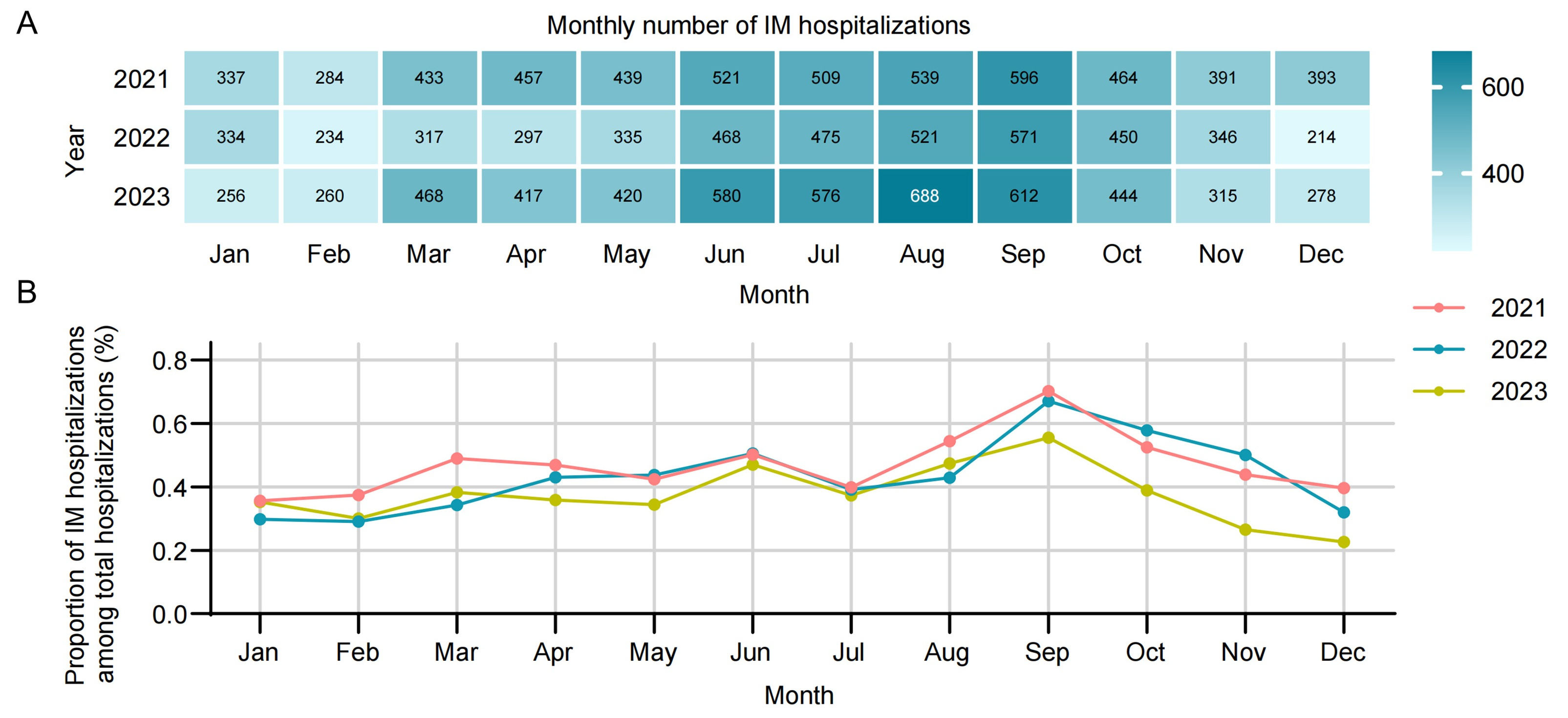
  • This multicenter study described the epidemiological characteristics, recorded first-ranked secondary diagnoses, and in-hospital burden of pediatric infectious mononucleosis (IM) hospitalizations in China during 2021-2023. Data were obtained from the FUTURE database. We identified hospitalizations with IM as the principal discharge diagnosis from discharge-record front pages at 31 tertiary children's hospitals between January 1, 2021, and December 31, 2023, and analyzed demographic, geographic, temporal, diagnostic, length-of-stay (LOS), and expense data using descriptive statistics and multivariable regression. Among 15,239 IM hospitalizations, representing 0.42% of all hospitalizations, the male-to-female ratio was 1.34. Children aged 4-6 years comprised the largest group, followed by those aged 1-3 and 7-12 years; 70.32% were urban residents, and admissions peaked in August and September. After adjustment for age, sex, seven-category geographic area, and month, the proportion of IM hospitalizations among all hospitalizations was lower in 2023 than in 2021-2022 (adjusted rate ratio, 0.822; 95% CI, 0.784-0.861; P < 0.001). A first-ranked secondary diagnosis was recorded in 68.29% of cases; bronchitis/pneumonia was the most common category, followed by hepatic dysfunction. Median LOS was 7 days, and median hospitalization expense was CNY 5563.07. Encephalitis was recorded in only 15 cases, which had the highest observed median LOS and hospitalization expenses. These findings provide a large multicenter baseline for the epidemiological patterns and in-hospital burden of pediatric IM hospitalizations across participating tertiary children's hospitals in China and may inform future surveillance and resource planning.

  • 加载中
  • 10.1016j.virs.2026.09.004-ESM.docx
    1. Bolis, V., Karadedos, C., Chiotis, I., Chaliasos, N.,Tsabouri, S., 2016. Atypical manifestations of Epstein-Barr virus in children: a diagnostic challenge. J Pediatr (Rio J), 92, 113-121.

    2. Cai, F., Gao, H.,Ye, Q., 2023. Seroprevalence of Epstein-Barr virus infection in children during the COVID-19 pandemic in Zhejiang, China. Front Pediatr, 11, 1064330.

    3. Chan, K.H., Tam, J.S., Peiris, J.S., Seto, W.H.,Ng, M.H., 2001. Epstein-Barr virus (EBV) infection in infancy. J Clin Virol, 21, 57-62.

    4. Cheng, H., Chen, D., Peng, X., Wu, P., Jiang, L.,Hu, Y., 2020. Clinical characteristics of Epstein-Barr virus infection in the pediatric nervous system. BMC Infect Dis, 20, 886.

    5. Gonzalez Saldana, N., Monroy Colin, V.A., Pina Ruiz, G.,Juarez Olguin, H., 2012. Clinical and laboratory characteristics of infectious mononucleosis by Epstein-Barr virus in Mexican children. BMC Res Notes, 5, 361.

    6. Hadinoto, V., Shapiro, M., Sun, C.C.,Thorley-Lawson, D.A., 2009. The dynamics of EBV shedding implicate a central role for epithelial cells in amplifying viral output. PLoS Pathog, 5, e1000496.

    7. Hu, H., Deng, H., Bi, J., Xu, Y., Li, S., Xie, Y., Sun, X., Wang, D., Li, X., Ouyang, W., et al., 2021. Clinical characteristics and effectiveness of antiviral agents in hospitalized children with infectious mononucleosis in China: A multicenter retrospective study. Pediatr Investig, 5, 188-194.

    8. Huang, Q.S., Wood, T., Jelley, L., Jennings, T., Jefferies, S., Daniells, K., Nesdale, A., Dowell, T., Turner, N., Campbell-Stokes, P., et al., 2021. Impact of the COVID-19 nonpharmaceutical interventions on influenza and other respiratory viral infections in New Zealand. Nat Commun, 12, 1001.

    9. Li, K., Rui, J., Song, W., Luo, L., Zhao, Y., Qu, H., Liu, H., Wei, H., Zhang, R., Abudunaibi, B., Wang, Y., Zhou, Z., Xiang, T.,Chen, T., 2024. Temporal shifts in 24 notifiable infectious diseases in China before and during the COVID-19 pandemic. Nat Commun, 15, 3891.

    10. Li, Z.J., Yu, L.J., Zhang, H.Y., Shan, C.X., Lu, Q.B., Zhang, X.A., Ren, X., Zhang, C.H., Wang, Y.F., Lin, S.H., et al., 2022. Broad Impacts of Coronavirus Disease 2019 (COVID-19) Pandemic on Acute Respiratory Infections in China: An Observational Study. Clin Infect Dis, 75, e1054-e1062.

    11. Liang, Y., Hou, L., Hou, G., Zhang, X., Chen, L.,Zhang, W., 2023. The influences of the COVID-19 pandemic on Epstein-Barr virus infection in children, Henan, China. J Infect, 86, 525-528.

    12. Liu, M., Wang, X., Zhang, L., Feng, G., Zeng, Y., Wang, R.,Xie, Z., 2022. Epidemiological characteristics and disease burden of infectious mononucleosis in hospitalized children in China: A nationwide retrospective study. Virol Sin, 37, 637-645.

    13. Luzuriaga, K.,Sullivan, J.L., 2010. Infectious mononucleosis. N Engl J Med, 362, 1993-2000.

    14. Macsween, K.F.,Crawford, D.H., 2003. Epstein-Barr virus-recent advances. Lancet Infect Dis, 3, 131-140.

    15. Prtoric, L., Sokota, A., Karabatic Knezovic, S., Tesovic, G.,Zidovec-Lepej, S., 2025. Clinical Features and Laboratory Findings of Hospitalized Children with Infectious Mononucleosis Caused by Epstein-Barr Virus from Croatia. Pathogens, 14, 374.

    16. Smatti, M.K., Al-Sadeq, D.W., Ali, N.H., Pintus, G., Abou-Saleh, H.,Nasrallah, G.K., 2018. Epstein-Barr Virus Epidemiology, Serology, and Genetic Variability of LMP-1 Oncogene Among Healthy Population: An Update. Front Oncol, 8, 211.

    17. Subspecialty Group of Infectious Diseases, T.S.O.P.C.M.A.,National Children's Epstein-Barr Virus Infection Cooperative, G., 2021. [Experts consensus on diagnosis and treatment of Epstein-Barr virus infection-related diseases in children]. Zhonghua Er Ke Za Zhi, 59, 905-911.

    18. Subspecialty Group of Infectious Diseases, T.S.O.P.C.M.A.,National Group of Epstein-Barr Virus Associated Diseases In, C., 2016. [Principle suggestions for diagnosis and treatment of main nontumorous Epstein-Barr virus-associated diseases in children]. Zhonghua Er Ke Za Zhi, 54, 563-568.

    19. Topp, S.K., Rosenfeldt, V., Vestergaard, H., Christiansen, C.B.,Von Linstow, M.L., 2015. Clinical characteristics and laboratory findings in Danish children hospitalized with primary Epstein-Barr virus infection. Infect Dis (Lond), 47, 908-914.

    20. Ye, Q.,Liu, H., 2022. Impact of non-pharmaceutical interventions during the COVID-19 pandemic on common childhood respiratory viruses - An epidemiological study based on hospital data. Microbes Infect, 24, 104911.

    21. Ye, Q.,Wang, D., 2022. Epidemiological changes of common respiratory viruses in children during the COVID-19 pandemic. J Med Virol, 94, 1990-1997.

  • 加载中

Figures(1)

Article Metrics

Article views(22) PDF downloads(0) Cited by()

Related
Proportional views

    Epidemiological characteristics and in-hospital burden of infectious mononucleosis among hospitalized children in China, 2021-2023

      Corresponding author: Zhengde Xie, xiezhengde@bch.com.cn
      Corresponding author: Ran Wang, randall@mail.ccmu.edu.cn
    • a. Laboratory of Infection and Virology, Beijing Pediatric Research Institute, Beijing Children's Hospital, Capital Medical University, National Center for Children's Health, Beijing, 100045, China;
    • b. Beijing Key Laboratory of Core Technologies for the Prevention and Treatment of Emerging Infectious Diseases in Children, Key Laboratory of Major Diseases in Children, Ministry of Education, National Clinical Research Center for Respiratory Diseases, Beijing, 100045, China;
    • c. Research Unit of Critical Infection in Children, 2019RU016, Chinese Academy of Medical Sciences, Beijing, 100045, China;
    • d. Big Data Center, Beijing Children's Hospital, Capital Medical University, National Center for Children's Health, Beijing, 100045, China;
    • e. Medical Record Management Office, Beijing Children's Hospital, Capital Medical University, National Center for Children's Health, Beijing, 100045, China

    Abstract: This multicenter study described the epidemiological characteristics, recorded first-ranked secondary diagnoses, and in-hospital burden of pediatric infectious mononucleosis (IM) hospitalizations in China during 2021-2023. Data were obtained from the FUTURE database. We identified hospitalizations with IM as the principal discharge diagnosis from discharge-record front pages at 31 tertiary children's hospitals between January 1, 2021, and December 31, 2023, and analyzed demographic, geographic, temporal, diagnostic, length-of-stay (LOS), and expense data using descriptive statistics and multivariable regression. Among 15,239 IM hospitalizations, representing 0.42% of all hospitalizations, the male-to-female ratio was 1.34. Children aged 4-6 years comprised the largest group, followed by those aged 1-3 and 7-12 years; 70.32% were urban residents, and admissions peaked in August and September. After adjustment for age, sex, seven-category geographic area, and month, the proportion of IM hospitalizations among all hospitalizations was lower in 2023 than in 2021-2022 (adjusted rate ratio, 0.822; 95% CI, 0.784-0.861; P < 0.001). A first-ranked secondary diagnosis was recorded in 68.29% of cases; bronchitis/pneumonia was the most common category, followed by hepatic dysfunction. Median LOS was 7 days, and median hospitalization expense was CNY 5563.07. Encephalitis was recorded in only 15 cases, which had the highest observed median LOS and hospitalization expenses. These findings provide a large multicenter baseline for the epidemiological patterns and in-hospital burden of pediatric IM hospitalizations across participating tertiary children's hospitals in China and may inform future surveillance and resource planning.

    Figure (1)  Reference (21) Relative (20)

    目录

    /

    DownLoad:  Full-Size Img  PowerPoint
    Return
    Return