. doi: 10.1016/j.virs.2026.03.006
Citation: Xin Zhang, Qianqian Xu, Junyan Jin, Hongxia Yan, Xiaofan Lu, Zhen Li, Zhiying Liu, Rui Wang, Lin Yuan, Zhenglai Ma, Tong Zhang, Hao Wu, Bin Su. The expression of CD39 on NK cells relates to poor HIV-1 suppression in treatment-naïve HIV-1-infected individuals: Association with elevated IL-10 secretion and TIGIT co-expression .VIROLOGICA SINICA, 2026, 41(2) : 293-302.  http://dx.doi.org/10.1016/j.virs.2026.03.006

CD39表达于NK细胞与未抗反转录病毒治疗HIV-1感染者的病毒学抑制差有关:与IL-10分泌增加和TIGIT共表达相关

  • 通讯作者: 粟斌, binsu@ccmu.edu.cn
  • 收稿日期: 2025-08-16
    录用日期: 2026-03-17
  • CD39通过减弱自然杀伤(NK)细胞对癌细胞的细胞毒性,在抗肿瘤中发挥抑制作用。然而,在未接受抗反转录病毒治疗的HIV-1感染者中,CD39表达对NK细胞的非细胞毒性功能影响尚不清楚。此项研究纳入34例急性HIV-1感染者(AHI,感染时长:1~3个月)、38例慢性HIV-1感染者(CHI,感染时长:9个月~3年)及24例HIV-1阴性健康对照(HC),探讨不同感染阶段NK细胞CD39表达在HIV-1病毒学抑制中的作用。研究采用流式细胞术分析NK细胞的免疫表型及功能特征,发现HIV-1感染后CD39在NK细胞表达显著上调,且在AHI和CHI感染者中,其阳性率均与HIV-1病毒载量呈正相关。与CD39- NK细胞相比,CD39+ NK细胞的活化能力降低;在AHI感染者中,CD39+ NK细胞的活化水平与HIV-1病毒载量呈正相关,而与CD4+ T细胞计数呈负相关。在CHI感染者中,总NK细胞、CD39+ NK细胞及CD39- NK细胞的白细胞介素-10(IL-10)产生能力均增强,且与HIV-1病毒载量呈正相关。此外,在AHI和CHI组中,NK细胞的总体IL-10分泌能力与CD39+ NK细胞频率呈正相关。在AHI和CHI感染者中,CD39+ NK细胞的TIGIT表达均低于CD39- NK细胞,而CD39+TIGIT+ NK细胞亚群的IL-10分泌能力显著增强。CD39外核苷酸酶活性抑制剂POM-1可增强HIV-1感染者及健康对照者NK细胞分泌IL-10,但减弱HIV-1感染者NK细胞分泌干扰素-γ(IFN-γ)。相反,CD39阻断抗体A1可降低HIV-1感染者和健康对照者NK细胞分泌IFN-γ,但不影响分泌IL-10。综上所述,研究结果揭示了一种新的CD39+ NK 细胞相关机制,该机制参与了 HIV-1 病毒控制失效的过程;同时提示,CD39(单独或与 TIGIT 联合)有望成为恢复未治疗 HIV-1 感染者 NK 细胞抗病毒功能的潜在靶点。

The expression of CD39 on NK cells relates to poor HIV-1 suppression in treatment-naïve HIV-1-infected individuals: Association with elevated IL-10 secretion and TIGIT co-expression

  • Corresponding author: Bin Su, binsu@ccmu.edu.cn
  • Received Date: 16 August 2025
    Accepted Date: 17 March 2026
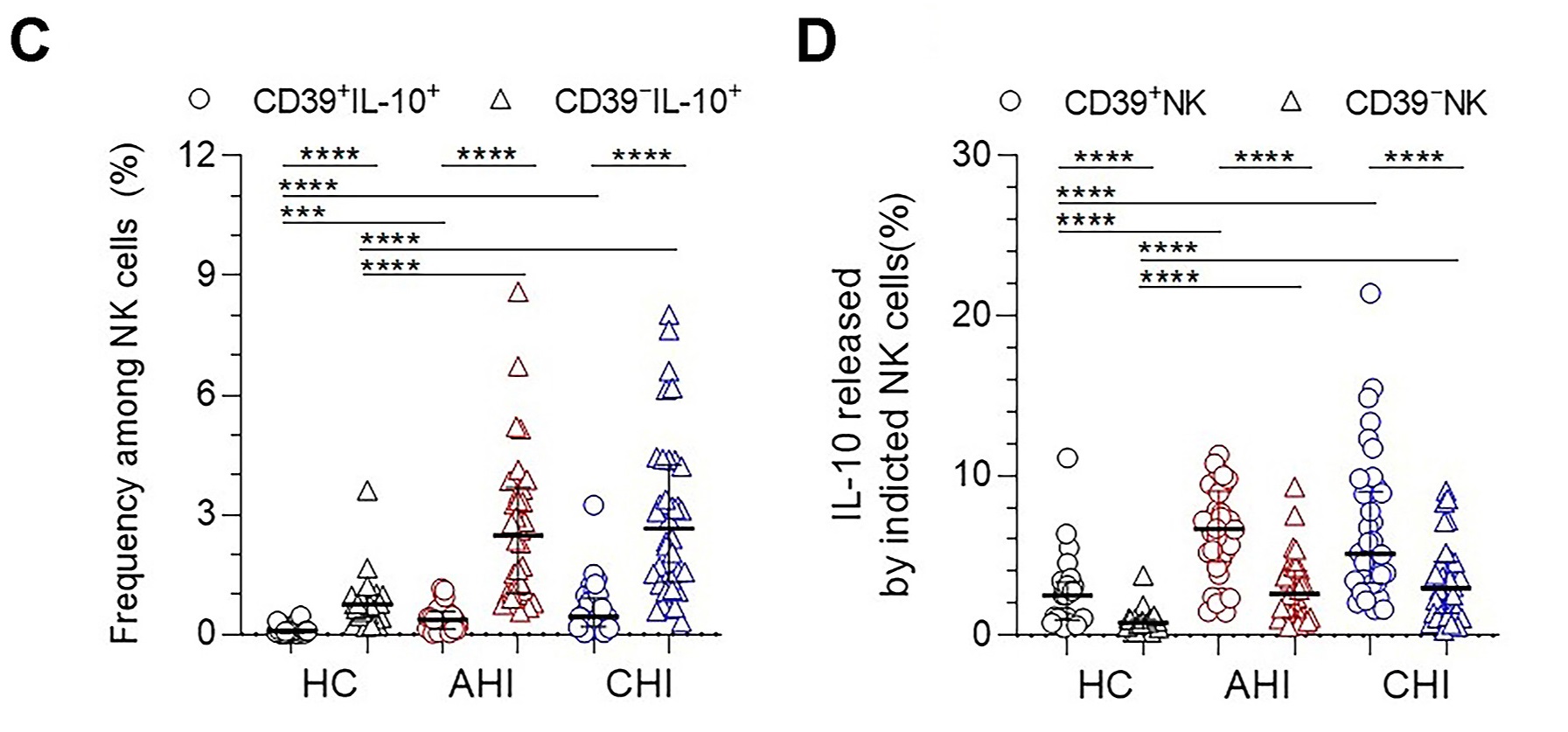
  • CD39 exerts an inhibitory effect on tumour progression by impairing the cytotoxic capacity of natural killer (NK) cells against cancer cells. However, the impact of CD39 expression on the non-cytolytic functions of NK cells in treatment-naïve human immunodeficiency virus type 1 (HIV-1)-infected individuals remains poorly understood. In this study, thirty-four individuals with acute HIV-1 infection (AHI), thirty-eight with chronic HIV-1 infection (CHI), and twenty-four HIV-1-negative healthy controls (HC) were enrolled to explore the role of CD39 expression on NK cells in HIV-1 suppression at different infection stages. Flow cytometry was employed to analyze the immune phenotype and functional characteristics of NK cells. We found that CD39 expression on NK cells was significantly upregulated following HIV-1 infection, and its positive rate was positively associated with HIV-1 viral load in both AHI and CHI individuals. Compared with CD39- NK cells, CD39+ NK cells exhibited reduced activation; in AHI individuals, the activation level of CD39+ NK cells was positively associated with HIV-1 viral load but inversely correlated with CD4+ T-cell counts. In CHI individuals, the interleukin-10 (IL-10)-producing capacity of total NK cells, CD39+ NK cells, and CD39- NK cells was enhanced and positively correlated with HIV-1 viral load. Additionally, across the AHI and CHI groups, the overall IL-10-secreting ability of NK cells was positively correlated with the frequency of CD39+ NK cells. In both AHI and CHI individuals, CD39+ NK cells showed lower T-cell immunoglobulin and ITIM domain (TIGIT) expression than CD39- NK cells, while the CD39+TIGIT+ NK cell subset displayed significantly stronger IL-10-secreting capacity. POM-1, an inhibitor of CD39 ectonucleotidase activity, could enhance IL-10 secretion by NK cells in both HIV-1-infected individuals and the majority of healthy controls, but attenuate interferon-γ (IFN-γ) secretion by NK cells in HIV-1-infected individuals. In contrast, the CD39-blocking antibody A1 reduced IFN-γ secretion without affecting IL-10 secretion by NK cells in both HIV-1-infected individuals and healthy controls. Our findings reveal a novel CD39+ NK cell-associated mechanism that contributes to ineffective HIV-1 control, and suggest that CD39, alone or combined with TIGIT, may serve as a promising target to restore antiviral NK cell function in treatment-naïve individuals living with HIV-1.

  • 加载中
    1. Alter G, Teigen N, Davis BT, Addo MM, Suscovich TJ, Waring MT, Streeck H, Johnston MN, Staller KD, Zaman MT, Yu XG, Lichterfeld M, Basgoz N, Rosenberg ES, Altfeld M. 2005. Sequential deregulation of nk cell subset distribution and function starting in acute HIV-1 infection. Blood, 106: 3366-3369.

    2. Bjorkstrom NK, Strunz B, Ljunggren HG. 2022. Natural killer cells in antiviral immunity. Nat Rev Immunol, 22: 112-123.

    3. Brauneck E, Leonhardt LG, Assemissen AM, Wahid Y, Kruppa M, Kruppa N, Kruger J, Menzel S, Koch-Nolte F, Kylies J, Weisel K, Bokemeyer C, Wellbrock J, Fiedler W, Viezens L, Brauneck F. 2025. Expression of the TIGIT axis and the CD39/CD73 purinergic pathway in bone metastasis-derived immune cells. Cancer Immunol Immunother, 74: 182.

    4. Brauneck F, Seubert E, Wellbrock J, Schulze Zur Wiesch J, Duan Y, Magnus T, Bokemeyer C, Koch-Nolte F, Menzel S, Fiedler W. 2021. Combined blockade of TIGIT and CD39 or A2AR enhances NK-92 cell-mediated cytotoxicity in AML. Int J Mol Sci, 22.

    5. Brockman MA, Kwon DS, Tighe DP, Pavlik DF, Rosato PC, Sela J, Porichis F, Le Gall S, Waring MT, Moss K, Jessen H, Pereyra F, Kavanagh DG, Walker BD, Kaufmann DE. 2009. Il-10 is up-regulated in multiple cell types during viremic HIV infection and reversibly inhibits virus-specific t cells. Blood, 114: 346-356.

    6. Dons'koi BV, Chernyshov VP, Osypchuk DV. 2011. Measurement of NK activity in whole blood by the CD69 up-regulation after co-incubation with K562, comparison with nk cytotoxicity assays and CD107a degranulation assay. J Immunol Methods, 372: 187-195.

    7. Fiebig EW, Wright DJ, Rawal BD, Garrett PE, Schumacher RT, Peddada L, Heldebrant C, Smith R, Conrad A, Kleinman SH, Busch MP. 2003. Dynamics of HIV viremia and antibody seroconversion in plasma donors: Implications for diagnosis and staging of primary hiv infection. Aids, 17: 1871-1879.

    8. Florez-Alvarez L, Hernandez JC, Zapata W. 2018. NK cells in HIV-1 infection: From basic science to vaccine strategies. Front Immunol, 9: 2290.

    9. Guo S, Han F, Zhu W. 2022. CD39 - a bright target for cancer immunotherapy. Biomed Pharmacother, 151: 113066.

    10. Hausler SF, Montalban del Barrio I, Strohschein J, Chandran PA, Engel JB, Honig A, Ossadnik M, Horn E, Fischer B, Krockenberger M, Heuer S, Seida AA, Junker M, Kneitz H, Kloor D, Klotz KN, Dietl J, Wischhusen J. 2011. Ectonucleotidases CD39 and CD73 on OvCA cells are potent adenosine-generating enzymes responsible for adenosine receptor 2A-dependent suppression of T cell function and NK cell cytotoxicity. Cancer Immunol Immunother, 60: 1405-1418.

    11. Huang X, Chen H, Li W, Li H, Jin X, Perelson AS, Fox Z, Zhang T, Xu X, Wu H. 2012. Precise determination of time to reach viral load set point after acute HIV-1 infection. J Acquir Immune Defic Syndr, 61: 448-454.

    12. Huang X, Liu X, Meyers K, Liu L, Su B, Wang P, Li Z, Li L, Zhang T, Li N, Chen H, Li H, Wu H. 2016. Cytokine cascade and networks among MSM HIV seroconverters: Implications for early immunotherapy. Sci Rep, 6: 36234.

    13. Jiang L, Wu T, Qu X, Li S, Jiang Q, Ren T, Liang J, Ding Y, Hua K, Tang Z, Qiu J. 2025. Targeting CD39 boosts PD-1 blockade antitumor therapeutic efficacy via strengthening CD8 + TILS function and recruiting B cells in cervical cancer. J Nanobiotechnology, 23: 413.

    14. Kang G, Zhao X, Sun J, Cheng C, Wang C, Tao L, Zong L, Yin W, Cong J, Li J, Wang X. 2023. A2AR limits IL-15-induced generation of CD39(+) NK cells with high cytotoxicity. Int Immunopharmacol, 114: 109567.

    15. Kyrysyuk O, Wucherpfennig KW. 2023. Designing cancer immunotherapies that engage T cells and NK cells. Annu Rev Immunol, 41: 17-38.

    16. Liu L, Hou Y, Deng C, Tao Z, Chen Z, Hu J, Chen K. 2022. Single cell sequencing reveals that CD39 inhibition mediates changes to the tumor microenvironment. Nat Commun, 13: 6740.

    17. Moore KW, de Waal Malefyt R, Coffman RL, O'Garra A. 2001. Interleukin-10 and the interleukin-10 receptor. Annu Rev Immunol, 19: 683-765.

    18. Ouyang W, O'Garra A. 2019. IL-10 family cytokines IL-10 and IL-22: From basic science to clinical translation. Immunity, 50: 871-891.

    19. Qian S, Xiong C, Wang M, Zhang Z, Fu Y, Hu Q, Ding H, Han X, Shang H, Jiang Y. 2022. CD38(+)CD39(+) NK cells associate with HIV disease progression and negatively regulate T cell proliferation. Front Immunol, 13: 946871.

    20. Rojas JM, Avia M, Martin V, Sevilla N. 2017. IL-10: A multifunctional cytokine in viral infections. J Immunol Res, 2017: 6104054.

    21. Rutz S, Ouyang W. 2016. Regulation of interleukin-10 expression. Adv Exp Med Biol, 941: 89-116.

    22. Sanchez-Cerrillo I, Agudo-Lera M, Popova O, Tsukalov I, Calvet-Mirabent M, de Los Santos I, Garcia-Fraile L, Fuentes P, Delgado-Arevalo C, Alcain J, Sanchez-Gaona N, Grau-Exposito J, Lazaro-Diez M, Munoz-Calleja C, Alfranca A, Genesca M, Prado JG, Vrbanac V, Balazs A, Buzon MJ, Toribio ML, Munoz-Fernandez MA, Sanchez-Madrid F, Martin-Gayo E. 2025. Combined dendritic cell and anti-TIGIT immunotherapy potentiates adaptive NK cells against HIV-1. EMBO Mol Med, 17: 1756-1793.

    23. Saxton RA, Tsutsumi N, Su LL, Abhiraman GC, Mohan K, Henneberg LT, Aduri NG, Gati C, Garcia KC. 2021. Structure-based decoupling of the pro- and anti-inflammatory functions of interleukin-10. Science, 371, eabc8433.

    24. Seshadri A, Brat GA, Yorkgitis BK, Giangola M, Keegan J, Nguyen JP, Li W, Nakahori Y, Wada T, Hauser C, Salim A, Askari R, Lederer JA. 2019. Altered monocyte and NK cell phenotypes correlate with posttrauma infection. J Trauma Acute Care Surg, 87: 337-341.

    25. Vendrame E, Seiler C, Ranganath T, Zhao NQ, Vergara R, Alary M, Labbe AC, Guedou F, Poudrier J, Holmes S, Roger M, Blish CA. 2020. TIGIT is upregulated by hiv-1 infection and marks a highly functional adaptive and mature subset of natural killer cells. Aids, 34: 801-813.

    26. Wang Y, Li Y, Chen J, Guo C, Yu X, Zhang Z, Fu Y, Han X, Hu Q, Ding H, Shang H, Jiang Y. 2025. Inhibition of TIGIT on NK cells improves their cytotoxicity and hiv reservoir eradication potential. mBio, 16: e0322624.

    27. Zhang X, Lu X, Cheung AKL, Zhang Q, Liu Z, Li Z, Yuan L, Wang R, Liu Y, Tang B, Xia H, Wu H, Zhang T, Su B. 2021. Analysis of the characteristics of TIGIT-expressing CD3(-)CD56(+)NK cells in controlling different stages of HIV-1 infection. Front Immunol, 12: 602492.

    28. Zheng Y, Li Y, Tang B, Zhao Q, Wang D, Liu Y, Guo M, Zhao S, Qi Y, Zhang Y, Huang L. 2020. IL-6-induced CD39 expression on tumor-infiltrating NK cells predicts poor prognosis in esophageal squamous cell carcinoma. Cancer Immunol Immunother, 69: 2371-2380.

    29. Zhong S, Zhang T, Tang L, Li Y. 2021. Cytokines and chemokines in HBV infection. Front Mol Biosci, 8: 805625.

  • 加载中
  • 10.1016j.virs.2026.03.006-ESM.doc

Figures(1)

Article Metrics

Article views(2081) PDF downloads(15) Cited by(0)

Related
Proportional views
    通讯作者: 陈斌, bchen63@163.com
    • 1. 

      沈阳化工大学材料科学与工程学院 沈阳 110142

    1. 本站搜索
    2. 百度学术搜索
    3. 万方数据库搜索
    4. CNKI搜索

    The expression of CD39 on NK cells relates to poor HIV-1 suppression in treatment-naïve HIV-1-infected individuals: Association with elevated IL-10 secretion and TIGIT co-expression

      Corresponding author: Bin Su, binsu@ccmu.edu.cn
    • a. Beijing Key Laboratory for HIV/AIDS Research, Sino-French Joint Laboratory for HIV/AIDS Research, Clinical and Research Center for Infectious Diseases, Beijing Youan Hospital, Capital Medical University, Beijing 100069, China;
    • b. Central Laboratory, Beijing Youan Hospital, Capital Medical University, Beijing 100069, China;
    • c. The Scientific and Technological Achievement Transformation Center, Beijing Youan Hospital, Capital Medical University, Beijing 100069, China

    Abstract: CD39 exerts an inhibitory effect on tumour progression by impairing the cytotoxic capacity of natural killer (NK) cells against cancer cells. However, the impact of CD39 expression on the non-cytolytic functions of NK cells in treatment-naïve human immunodeficiency virus type 1 (HIV-1)-infected individuals remains poorly understood. In this study, thirty-four individuals with acute HIV-1 infection (AHI), thirty-eight with chronic HIV-1 infection (CHI), and twenty-four HIV-1-negative healthy controls (HC) were enrolled to explore the role of CD39 expression on NK cells in HIV-1 suppression at different infection stages. Flow cytometry was employed to analyze the immune phenotype and functional characteristics of NK cells. We found that CD39 expression on NK cells was significantly upregulated following HIV-1 infection, and its positive rate was positively associated with HIV-1 viral load in both AHI and CHI individuals. Compared with CD39- NK cells, CD39+ NK cells exhibited reduced activation; in AHI individuals, the activation level of CD39+ NK cells was positively associated with HIV-1 viral load but inversely correlated with CD4+ T-cell counts. In CHI individuals, the interleukin-10 (IL-10)-producing capacity of total NK cells, CD39+ NK cells, and CD39- NK cells was enhanced and positively correlated with HIV-1 viral load. Additionally, across the AHI and CHI groups, the overall IL-10-secreting ability of NK cells was positively correlated with the frequency of CD39+ NK cells. In both AHI and CHI individuals, CD39+ NK cells showed lower T-cell immunoglobulin and ITIM domain (TIGIT) expression than CD39- NK cells, while the CD39+TIGIT+ NK cell subset displayed significantly stronger IL-10-secreting capacity. POM-1, an inhibitor of CD39 ectonucleotidase activity, could enhance IL-10 secretion by NK cells in both HIV-1-infected individuals and the majority of healthy controls, but attenuate interferon-γ (IFN-γ) secretion by NK cells in HIV-1-infected individuals. In contrast, the CD39-blocking antibody A1 reduced IFN-γ secretion without affecting IL-10 secretion by NK cells in both HIV-1-infected individuals and healthy controls. Our findings reveal a novel CD39+ NK cell-associated mechanism that contributes to ineffective HIV-1 control, and suggest that CD39, alone or combined with TIGIT, may serve as a promising target to restore antiviral NK cell function in treatment-naïve individuals living with HIV-1.

    Figure (1)  Reference (29) Relative (20)

    目录

    /

    DownLoad:  Full-Size Img  PowerPoint
    Return
    Return