. doi: 10.1016/j.virs.2026.07.005
Citation: Yuqing Zhou, Xiao Wang, Lu Zhang, Yang Yuan, Tianchun Liu, Yuqin Yang, Yingjie Zheng, Bing Zhao. Whole-genome evolutionary dynamics of human parainfluenza virus type 3 in Shanghai, China, 2016-2024 .VIROLOGICA SINICA, 2026, 41(4) : 993-998.  http://dx.doi.org/10.1016/j.virs.2026.07.005

2016–2024年中国上海市人副流感病毒3型分子进化特征研究

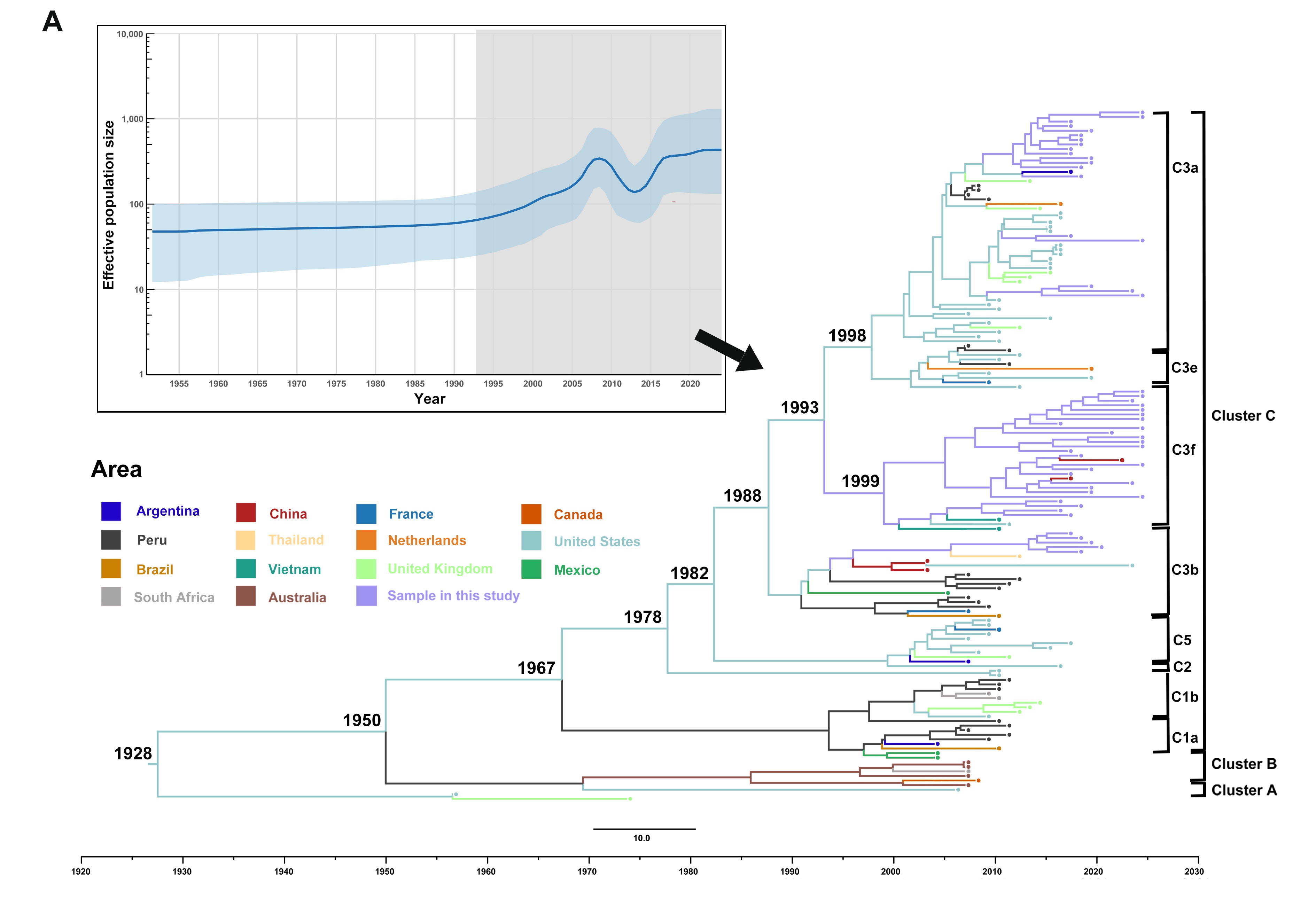
  • 人副流感病毒3型(Human parainfluenza virus type 3,HPIV-3)是引起急性呼吸道感染(acute respiratory infection,ARI)的重要病毒病原体,对儿童、老年人及免疫功能低下人群具有较高疾病负担。目前针对HPIV-3尚无疫苗和特异性抗病毒药物,其分子进化研究仍主要基于HN基因开展。本研究基于2016–2024年上海地区ARI病例临床样本,采用Primal Scheme设计引物结合高通量测序获得HPIV-3全基因组序列,采用Mega、Beast等软件进行基因分型、重组、选择压力及进化分析。结果显示,本研究中50株HPIV-3临床株均属于Cluster C中C3型,其中以C3f和C3a亚型为主,表明上海地区呈多亚型共流行现象。基于HN基因与全基因组构建的系统进化树存在拓扑结构及亚型分型不一致现象。重组分析在HN基因及多个其他基因区域中均检测到潜在重组信号,HPIV-3最近共同祖先时间(tMRCA)约为1925.6年,早于既往基于部分HN基因序列的估计结果,表明单基因分析可能无法充分反映HPIV-3的真实进化历程;群体动态分析发现,1990年前病毒群体规模总体较为稳定,此后经历了两次扩张阶段,表明HPIV-3在近几十年可能经历了持续的谱系扩增与传播。熵值及选择压力分析发现,L基因具有最高的遗传多样性,并富集最多的正向选择位点,提示其在病毒进化与宿主适应过程中可能发挥重要作用。相比之下,HN基因和P基因相对保守,可作为后续分子监测与检测靶标的候选区域。本研究从全基因组层面对中国地区HPIV-3开展了系统的分子进化分析,强调了全基因组测序在谱系分型、分子监测及病毒进化研究中的重要价值。未来应结合单基因与全基因组监测策略,以提升HPIV-3长期分子监测与进化研究能力,为疫苗与抗病毒策略研发提供分子依据。

Whole-genome evolutionary dynamics of human parainfluenza virus type 3 in Shanghai, China, 2016-2024

  • Highlights
    1 Fifty whole-genome sequencing revealed co-circulating HPIV-3 C3 sub-lineages C3f and C3a in Shanghai, China.
    2 Whole-genome phylogeny dated the HPIV-3 tMRCA to ~1925.6 and revealed two post-1990 demographic expansions.
    3 Recombination signals detected in the HN gene and other regions may lead to discordance in partial-gene phylogenies.
    4 The L gene showed the highest variability and harbored the largest number of putative positively selected sites.

  • 加载中
    1. Aso, J., Kimura, H., Ishii, H., Saraya, T., Kurai, D., Nagasawa, K., Matsushima, Y., Ryo, A., Takizawa, H., 2020. Molecular evolution of the hemagglutinin-neuraminidase (HN) gene in human respirovirus 3. Virus Res. 277, 197824.

    2. Bose, M.E., Shrivastava, S., He, J., Nelson, M.I., Bera, J., Fedorova, N., Halpin, R., Town, C.D., Lorenzi, H.A., Amedeo, P., Gupta, N., Noyola, D.E., Videla, C., Kok, T., Buys, A., Venter, M., Vabret, A., Cordey, S., Henrickson, K.J., 2019. Sequencing and analysis of globally obtained human parainfluenza viruses 1 and 3 genomes. PLOS ONE 14, e0220057.

    3. Elusah, J., Bulimo, W.D., Opanda, S.M., Symekher, S.L., Wamunyokoli, F., 2020. Genetic diversity and evolutionary analysis of human respirovirus type 3 strains isolated in Kenya using complete hemagglutinin-neuraminidase (HN) gene. PLOS ONE 15, e0229355.

    4. Godoy, C., Peremiquel-Trillas, P., Andres, C., Gimferrer, L., Uriona, S.M., Codina, M.G., Armadans, L., Martin, M.D.C., Fuentes, F., Esperalba, J., Campins, M., Pumarola, T., Anton, A., 2016. A molecular epidemiological study of human parainfluenza virus type 3 at a tertiary university hospital during 2013-2015 in Catalonia, Spain. Diagn. Microbiol. Infect. Dis. 86, 153-159.

    5. Greenbaum, B.D., Ghedin, E., 2015. Viral evolution: beyond drift and shift. Curr. Opin. Microbiol. 26, 109-115.

    6. Guo, Y., Li, L., Lai, Q., Wang, Y., Li, W., 2024. Molecular Epidemiology of Human Parainfluenza Virus Type 3 in Children With Acute Respiratory Tract Infection in Hangzhou. Influenza Other Respir. Viruses 18, e13351.

    7. Guo, Y.N., De, R., Wang, F.M., Han, Z.Z., Liu, L.Y., Sun, Y., Yao, Y., Ma, X.L., Liu, S., Zhu, C., Qu, D., Zhao, L.Q., 2025. Molecular Characterization of New Recombinant Human Adenoviruses Detected in Children with Acute Respiratory Tract Infections in Beijing, China, 2022-2023. Biomed. Environ. Sci. BES 38, 1071-1081.

    8. Han, J.Y., Suh, W., Han, S.B., 2022. Seasonal epidemiological and clinical characteristics of pediatric patients with human parainfluenza virus infection by serotype: a retrospective study. Virol. J. 19, 141.

    9. Lefkowitz, E.J., Dempsey, D.M., Hendrickson, R.C., Orton, R.J., Siddell, S.G., Smith, D.B., 2018. Virus taxonomy: the database of the International Committee on Taxonomy of Viruses (ICTV). Nucleic Acids Res. 46, D708-D717.

    10. Matsumoto, Y., Ohta, K., Yumine, N., Goto, H., Nishio, M., 2015. Identification of two essential aspartates for polymerase activity in parainfluenza virus L protein by a minireplicon system expressing secretory luciferase. Microbiol. Immunol. 59, 676-683.

    11. Russell, C.J., Simoes, E.A.F., Hurwitz, J.L., 2018. Vaccines for the Paramyxoviruses and Pneumoviruses: Successes, Candidates, and Hurdles. Viral Immunol. 31, 133-141.

    12. Shao, N., Liu, B., Xiao, Y., Wang, X., Ren, L., Dong, J., Sun, L., Zhu, Y., Zhang, T., Yang, F., 2021. Genetic Characteristics of Human Parainfluenza Virus Types 1-4 From Patients With Clinical Respiratory Tract Infection in China. Front. Microbiol. 12, 679246.

    13. Stearns, K., Lampe, G., Hanan, R., Marcink, T., Niewiesk, S., Sternberg, S.H., Greninger, A.L., Porotto, M., Moscona, A., 2024. Human parainfluenza virus 3 field strains undergo extracellular fusion protein cleavage to activate entry. mBio 15, e0232724.

    14. Takahashi, M., Nagasawa, K., Saito, K., Maisawa, S.-I., Fujita, K., Murakami, K., Kuroda, M., Ryo, A., Kimura, H., 2018. Detailed genetic analyses of the HN gene in human respirovirus 3 detected in children with acute respiratory illness in the Iwate Prefecture, Japan. Infect. Genet. Evol. J. Mol. Epidemiol. Evol. Genet. Infect. Dis. 59, 155-162.

  • 加载中
  • 10.1016j.virs.2026.07.005-ESM3.xlsx
    10.1016j.virs.2026.07.005-ESM1.docx
    10.1016j.virs.2026.07.005-ESM4.xlsx
    10.1016j.virs.2026.07.005-ESM2.xlsx

Figures(1)

Article Metrics

Article views(384) PDF downloads(0) Cited by(0)

Related
Proportional views
    通讯作者: 陈斌, bchen63@163.com
    • 1. 

      沈阳化工大学材料科学与工程学院 沈阳 110142

    1. 本站搜索
    2. 百度学术搜索
    3. 万方数据库搜索
    4. CNKI搜索

    Whole-genome evolutionary dynamics of human parainfluenza virus type 3 in Shanghai, China, 2016-2024

      Corresponding author: Yingjie Zheng, yjzheng@fudan.edu.cn
      Corresponding author: Bing Zhao, zerg8424@hotmail.com
    • a. Shanghai Pudong New Area Center for Disease Control and Prevention (Shanghai Pudong New Area Health Supervision Institute), Shanghai 200136, China;
    • b. Institute of Pathogen Biology, Chinese Academy of Medical Sciences & Peking Union Medical College, Beijing 100730, China;
    • c. Department of Epidemiology, School of Public Health, Fudan University, Shanghai 200032, China;
    • d. Key Laboratory for Health Technology Assessment, National Commission of Health and Family Planning, Fudan University, Shanghai 200032, China;
    • e. Laboratory of Public Health Safety, Ministry of Education, School of Public Health, Fudan University, Shanghai 200032, China

    Abstract: Highlights
    1 Fifty whole-genome sequencing revealed co-circulating HPIV-3 C3 sub-lineages C3f and C3a in Shanghai, China.
    2 Whole-genome phylogeny dated the HPIV-3 tMRCA to ~1925.6 and revealed two post-1990 demographic expansions.
    3 Recombination signals detected in the HN gene and other regions may lead to discordance in partial-gene phylogenies.
    4 The L gene showed the highest variability and harbored the largest number of putative positively selected sites.

    Figure (1)  Reference (14) Relative (20)

    目录

    /

    DownLoad:  Full-Size Img  PowerPoint
    Return
    Return