-
Adams, J.M., Cory, S., 2018. The BCL-2 arbiters of apoptosis and their growing role as cancer targets. Cell Death Differ, 25, 27-36.
-
Berke, J.M., Tan, Y., Sauviller, S., Wu, D.T., Zhang, K., Conceicao-Neto, N., Blazquez Moreno, A., Kong, D., Kukolj, G., Li, C., Zhu, R., Najera, I., Pauwels, F., 2024. Class A capsid assembly modulator apoptotic elimination of hepatocytes with high HBV core antigen level in vivo is dependent on de novo core protein translation. J Virol, 98, e0150223.
-
Carrageta, D.F., Freire-Brito, L., Oliveira, P.F., Alves, M.G., 2022. Evaluation of Human Spermatozoa Mitochondrial Membrane Potential Using the JC-1 Dye. Curr Protoc, 2, e531.
-
Clavier, A., Rincheval-Arnold, A., Colin, J., Mignotte, B., Guenal, I., 2016. Apoptosis in Drosophila: which role for mitochondria? Apoptosis, 21, 239-251.
-
Dai, H., Ding, H., Meng, X.W., Lee, S.H., Schneider, P.A., Kaufmann, S.H., 2013. Contribution of Bcl-2 phosphorylation to Bak binding and drug resistance. Cancer Res, 73, 6998-7008.
-
Dashti, A., Sukkestad, S., Horner, A.M., Neja, M., Siddiqi, Z., Waller, C., Goldy, J., Monroe, D., Lin, A., Schoof, N., et al., 2023. AZD5582 plus SIV-specific antibodies reduce lymph node viral reservoirs in antiretroviral therapy-suppressed macaques. Nat Med, 29, 2535-2546.
-
Guieze, R., Liu, V.M., Rosebrock, D., Jourdain, A.A., Hernandez-Sanchez, M., Martinez Zurita, A., Sun, J., Ten Hacken, E., Baranowski, K., Thompson, P.A., et al., 2019. Mitochondrial Reprogramming Underlies Resistance to BCL-2 Inhibition in Lymphoid Malignancies. Cancer Cell, 36, 369-384.e313.
-
Han, C.R., Jun Do, Y., Lee, J.Y., Kim, Y.H., 2014. Prometaphase arrest-dependent phosphorylation of Bcl-2 and Bim reduces the association of Bcl-2 with Bak or Bim, provoking Bak activation and mitochondrial apoptosis in nocodazole-treated Jurkat T cells. Apoptosis, 19, 224-240.
-
Hong, Y.A., Inagi, R., 2025. Endoplasmic reticulum-mediated organelle crosstalk in kidney disease. Nat Rev Nephrol, 21, 736-755.
-
Joniova, J., Misuth, M., Sureau, F., Miskovsky, P., Nadova, Z., 2014. Effect of PKCα expression on Bcl-2 phosphorylation and cell death by hypericin. Apoptosis, 19, 1779-1792.
-
Kar, J., Hirohama, M., Nakayama, K., Lee, S., Kawaguchi, A., 2026. Microtubule detyrosination links inflammasome activation to apoptotic cell death in macrophages upon influenza A virus infection. J Virol, 100, e0184725.
-
Ke, D., Yu, Y., Li, C., Han, J., Xu, J., 2022. Phosphorylation of BCL2 at the Ser70 site mediates RANKL-induced osteoclast precursor autophagy and osteoclastogenesis. Mol Med, 28, 22.
-
Kim, H., Park, S.Y., Lee, S.Y., Kwon, J.H., Byun, S., Ko, B., Yoo, J.Y., Kim, B.S., Lim, B.J., Yoon, H.G., 2025. Loss of p300 in proximal tubular cells reduces renal fibrosis and endothelial-mesenchymal transition. EMBO Mol Med, 17, 1575-1598.
-
Kumari, S., Dhapola, R., Reddy, D.H., 2023. Apoptosis in Alzheimer's disease: insight into the signaling pathways and therapeutic avenues. Apoptosis, 28, 943-957.
-
Kvansakul, M., Hinds, M.G., 2015. The Bcl-2 family: structures, interactions and targets for drug discovery. Apoptosis, 20, 136-150.
-
Li, T., Zhao, L., Li, Y., Dang, M., Lu, J., Lu, Z., Huang, Q., Yang, Y., Feng, Y., Wang, X., et al., 2023. PPM1K mediates metabolic disorder of branched-chain amino acid and regulates cerebral ischemia-reperfusion injury by activating ferroptosis in neurons. Cell Death Dis, 14, 634.
-
Li, Z.M., Duan, S.H., Yu, T.M., Li, B., Zhang, W.K., Zhou, C.M., Yu, X.J., 2024. Bunyavirus SFTSV NSs utilizes autophagy to escape the antiviral innate immune response. Autophagy, 20, 2133-2145.
-
Liu, J., Duan, Y., Xiao, Q., Deng, S., Li, A., Wu, D., Wu, J., Liu, C., Yi, H., Wang, M., Shu, G., Yin, G., 2026. Ubiquitination of MEIS1 by MDM2 serves as a switch for p53 stabilization and DNA damage response activation. Cell Death Differ, 10.1038/s41418-026-01714-9.
-
Low, I.C., Loh, T., Huang, Y., Virshup, D.M., Pervaiz, S., 2014. Ser70 phosphorylation of Bcl-2 by selective tyrosine nitration of PP2A-B56δ stabilizes its antiapoptotic activity. Blood, 124, 2223-2234.
-
Lynch, C.J., Adams, S.H., 2014. Branched-chain amino acids in metabolic signalling and insulin resistance. Nat Rev Endocrinol, 10, 723-736.
-
Mu, L., Ye, Z., Hu, J., Zhang, Y., Chen, K., Sun, H., Li, R., Mao, W., Long, X., Zhang, C., Lai, Y., Liu, J., Zhao, Y., Qiao, J., 2023. PPM1K-regulated impaired catabolism of branched-chain amino acids orchestrates polycystic ovary syndrome. EBioMedicine, 89, 104492.
-
Nakase, H., Wagatsuma, K., Kobayashi, T., Matsumoto, T., Esaki, M., Watanabe, K., Kunisaki, R., Takeda, T., Arai, K., Ibuka, T., et al., 2024. Involvement of Mediterranean fever gene mutations in colchicine-responsive enterocolitis: a retrospective cohort study. EBioMedicine, 110, 105454.
-
Nishi, K., Yoshii, A., Abell, L., Zhou, B., Frausto, R., Ritterhoff, J., Mcmillen, T.S., Sweet, I., Wang, Y., Gao, C., Tian, R., 2023. Branched-chain keto acids inhibit mitochondrial pyruvate carrier and suppress gluconeogenesis in hepatocytes. Cell Rep, 42, 112641.
-
Pistritto, G., Trisciuoglio, D., Ceci, C., Garufi, A., D'orazi, G., 2016. Apoptosis as anticancer mechanism: function and dysfunction of its modulators and targeted therapeutic strategies. Aging (Albany NY), 8, 603-619.
-
Qian, H., Tian, L., Liu, W., Liu, L., Li, M., Zhao, Z., Lei, X., Zheng, W., Zhao, Z., Zheng, X., 2024. Adenovirus type 5-expressing Gn induces better protective immunity than Gc against SFTSV infection in mice. NPJ Vaccines, 9, 194.
-
Roberts, A.W., Wei, A.H., Huang, D.C.S., 2021. BCL2 and MCL1 inhibitors for hematologic malignancies. Blood, 138, 1120-1136.
-
Shadman, M., Davids, M.S., 2025. How I treat patients with CLL after prior treatment with a covalent BTK inhibitor and a BCL-2 inhibitor. Blood, 146, 2029-2036.
-
Sheng, R., Cheng, T., Wang, Y., Wen, H., 2025. Molecular evolution and geographic migration of severe fever with thrombocytopenia syndrome virus in Asia. PLoS Pathog, 21, e1012970.
-
Stanford, S.M., Bottini, N., 2023. Targeting protein phosphatases in cancer immunotherapy and autoimmune disorders. Nat Rev Drug Discov, 22, 273-294.
-
Sumi, K., Shioyama, M., Munakata, K., Takasugi, S., Morifuji, M., Nakamura, K., 2026. Lauric acid engages an O-GlcNAc-sensitive BCKDH regulatory node to modulate branched-chain amino acid oxidation in skeletal myotubes. J Biol Chem, 302, 113345.
-
Tang, Q., Tang, K., Markby, G.R., Parys, M., Phadwal, K., Macrae, V.E., Corcoran, B.M., 2025. Autophagy regulates cellular senescence by mediating the degradation of CDKN1A/p21 and CDKN2A/p16 through SQSTM1/p62-mediated selective autophagy in myxomatous mitral valve degeneration. Autophagy, 21, 1433-1455.
-
Ugun-Klusek, A., Theodosi, T.S., Fitzgerald, J.C., Burte, F., Ufer, C., Boocock, D.J., Yu-Wai-Man, P., Bedford, L., Billett, E.E., 2019. Monoamine oxidase-A promotes protective autophagy in human SH-SY5Y neuroblastoma cells through Bcl-2 phosphorylation. Redox Biol, 20, 167-181.
-
Vervloessem, T., Sasi, B.K., Xerxa, E., Karamanou, S., Kale, J., La Rovere, R.M., Chakraborty, S., Sneyers, F., Vogler, M., Economou, A., Laurenti, L., Andrews, D.W., Efremov, D.G., Bultynck, G., 2020. BDA-366, a putative Bcl-2 BH4 domain antagonist, induces apoptosis independently of Bcl-2 in a variety of cancer cell models. Cell Death Dis, 11, 769.
-
Wang, Q., Zhao, J., Zhang, M., Sun, M., Fu, Z.F., Zhao, L., Zhou, M., 2024. Neuroinvasive virus utilizes a lipid droplet surface protein, perilipin2, to restrict apoptosis by decreasing Bcl-2 ubiquitination. J Virol, 98, e0160724.
-
Xu, H., Jian, X., Wen, Y., Xu, M., Jin, R., Wu, X., Zhou, F., Cao, J., Xiao, G., Peng, K., Xie, Y., Chen, H., Zhang, L., 2024. A nanoluciferase SFTSV for rapid screening antivirals and real-time visualization of virus infection in mice. EBioMedicine, 99, 104944.
-
Yang, D., Liu, H., Cai, Y., Lu, K., Zhong, X., Xing, S., Song, W., Zhang, Y., Ye, L., Zhu, X., Wang, T., Zhang, P., Li, S.T., Feng, J., Jia, W., Zhang, H., Gao, P., 2022. Branched-chain amino acid catabolism breaks glutamine addiction to sustain hepatocellular carcinoma progression. Cell Rep, 41, 111691.
-
Yang, X., Chan, C., 2009. Repression of PKR mediates palmitate-induced apoptosis in HepG2 cells through regulation of Bcl-2. Cell Res, 19, 469-486.
-
Zhang, K., Donovan, T., Sucharita, S., Brownlie, R., Snider, M., Tikoo, S.K., Van Drunen Littel-Van Den Hurk, S., 2019. US3 Kinase-Mediated Phosphorylation of Tegument Protein VP8 Plays a Critical Role in the Cellular Localization of VP8 and Its Effect on the Lipid Metabolism of Bovine Herpesvirus 1-Infected Cells. J Virol, 93, e02151-18.
-
Zhang, W.K., Yan, J.M., Chu, M., Li, B., Gu, X.L., Jiang, Z.Z., Li, Z.M., Liu, P.P., Yu, T.M., Zhou, C.M., Yu, X.J., 2025. Bunyavirus SFTSV nucleoprotein exploits TUFM-mediated mitophagy to impair antiviral innate immunity. Autophagy, 21, 102-119.
-
Zhang, Y., Zhang, L., Xu, H., Yin, X., Zheng, X., Cui, N., Lv, H., Zhang, X., Fang, L., Zhang, L., Chen, H., Liu, W., Li, H., 2026. Severe fever with thrombocytopenia syndrome virus infection of the male reproductive tract induces pathology and inflammation. Nat Microbiol, 11, 1286-1301.
-
Zhao, G., Jia, M., Zhu, S., Ren, H., Wang, G., Xin, G., Sun, M., Wang, X., Lin, Q., Jiang, Q., Zhang, C., 2024. Mitotic ER-mitochondria contact enhances mitochondrial Ca(2+) influx to promote cell division. Cell Rep, 43, 114794.
-
Zheng, L., Fu, S., Zeng, M., Li, L., Wang, D., Gao, S., Zhang, Y., Zhang, C., Fei, S., Ye, X., Chen, L., Chen, Q., Wang, Y., Zhou, X., Xie, Y., Hu, B., Wu, J., 2025. Rice ragged stunt virus Pns10 induces mitochondrial-mediated apoptosis to promote viral infection in Nilaparvata lugens through disrupting the NlNDUFS1-NlPHB2 interaction. PLoS Pathog, 21, e1013415.








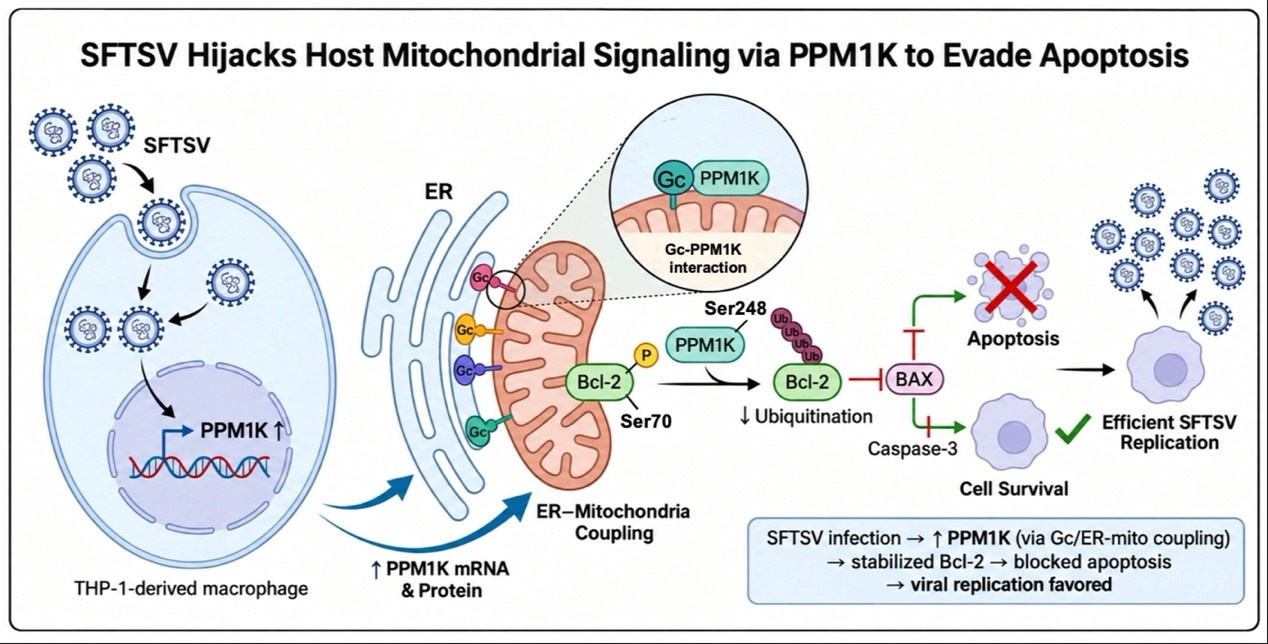




 DownLoad: