. doi: 10.1016/j.virs.2026.10.001
Citation: Xiaoyu Tang, Huang Chao, Chenyu Li, Jingshuai Sun, Wenjie Li, Yuan Sun, Tian Lan, Jingyun Ma. Multiomics reveals alterations in the gut microbiome, host proteins, and host metabolites correlating with SADS-CoV pathogenicity and the immune response in piglets .VIROLOGICA SINICA, 2026, 41(5) : 1145-1164.  http://dx.doi.org/10.1016/j.virs.2026.10.001

多组学解释仔猪肠道微生物组、宿主蛋白和宿主代谢物与SADS-CoV致病性和免疫应答相关的改变

  • 猪急性腹泻综合征冠状病毒(SADS-CoV)感染可导致仔猪出现严重急性腹泻、呕吐和致死性症状。为探索肠道菌群调控病毒感染的分子机制,我们对感染高致病性SADS-CoVP7毒株或低致病性SADS-CoV P83毒株的仔猪的肠黏膜和粪便样本进行了多组学分析(蛋白质组学、代谢组学、短链脂肪酸)和16SrRNA测序。在高致病性感染组中,回肠黏膜和粪便中肠杆菌科(Enterobacteriaceae)的丰度显著高于对照组和低致病性感染组。受高致病性病毒SADS-CoVP7感染猪的短链脂肪酸(SCFAs)浓度显著低于低致病性SADS-CoVP83感染猪,且SCFAs水平与回肠黏膜中肠杆菌科和大肠杆菌(Escherichia coli)的丰度呈负相关。与低致病性病毒感染组相比,高致病性病毒组的差异表达蛋白主要与细胞外基质-受体相互作用和黏着斑通路相关。高致病性病毒SADS-CoVP7感染后,大肠杆菌O157对IPEC-J2细胞的黏附力和黏附数量均增加。研究表明,高致病性SADS-CoVP7毒株通过重塑肠道菌群、激活整合素α5介导的细胞外基质-病原体相互作用,加剧肠道炎症和组织损伤。相比之下,低致病性SADS-CoVP83毒株可能由于缺乏这些调控途径而表现出减弱的毒力。本研究旨在阐明高致病性和低致病性SADS-CoV毒株的致病机制,为广谱抗冠状病毒药物和合理疫苗设计提供重要见解。

Multiomics reveals alterations in the gut microbiome, host proteins, and host metabolites correlating with SADS-CoV pathogenicity and the immune response in piglets

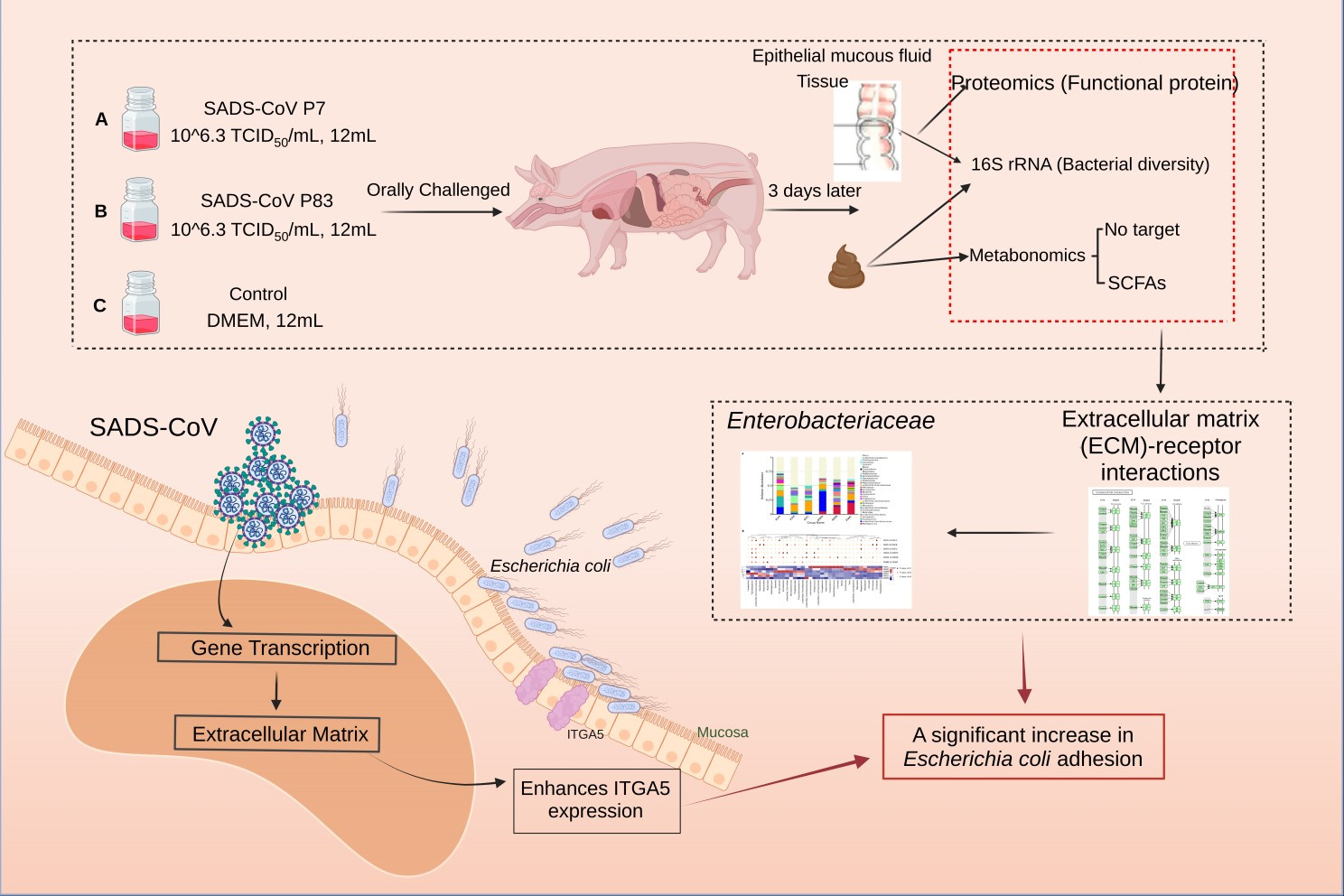
  • Swine acute diarrhea syndrome coronavirus (SADS-CoV) infection causes severe acute diarrhea, vomiting, and lethality in piglets. To explore the molecular mechanisms by which intestinal flora regulate viral infection, we conducted multi-omics analysis [proteomics, metabolomics, short-chain fatty acids (SCFA) quantification] and 16S rRNA sequencing on intestinal mucosal and fecal samples from piglets infected with highly pathogenic SADS-CoV P7 stain or low-pathogenic SADS-CoV P83 strain. In both ileal mucosa and fecal samples, the abundance of Enterobacteriaceae was markedly higher in the highly pathogenic strain infection group than in either the control group or the low-pathogenic strain infection group. The concentration of SCFAs was significantly lower in the highly pathogenic SADS-CoV infected pigs than the low-pathogenic strain infected pigs, and SCFA levels were negatively correlated with the abundance of Enterobacteriaceae and Escherichia coli in the ileal mucosa. Compared with the low-pathogenic group, differentially expressed proteins in the highly pathogenic group were mainly associated with extracellular matrix-receptor interaction and focal adhesion pathways. SADS-CoV P7 infection increased both the adhesion capacity and the number of adherent Escherichia coli O157 on IPEC-J2 cells. This study demonstrates that the highly pathogenic SADS-CoV P7 strain remodels gut microbiota to exacerbate intestinal inflammation and tissue damage via activating integrin alpha5-mediated extracellular matrix-pathogen interactions. In contrast, the low-pathogenic SADS-CoV P83 strain exhibits attenuated virulence due to a lack of these regulatory pathways. This study elucidates the distinct pathogenic mechanisms of highly pathogenic and low-pathogenic SADS-CoV strains and provides critical insights for the development of broad-spectrum anti-coronavirus therapeutics and rational vaccine design.

  • 加载中
    1. Alber, A., Costa, T., Chintoan-Uta, C., Bryson, K.J., Kaiser, P., Stevens, M.P., Vervelde, L., 2019. Dose-Dependent Differential Resistance of Inbred Chicken Lines to Avian Pathogenic Escherichia coli Challenge. Avian Pathol. 48, 157-167.

    2. Bisht, S., Singh, K.S., Choudhary, R., Kumar, S., Grover, S., Mohanty, A.K., Pande, V., Kaushik, J.K., 2018. Expression of Fibronectin-Binding Protein of L. acidophilus NCFM and in vitro Refolding to Adhesion Capable Native-Like Protein from Inclusion Bodies. Protein Expr. Purif. 145, 7-13.

    3. Brockmeier, S.L., Loving, C.L., Palmer, M.V., Spear, A., Nicholson, T.L., Faaberg, K.S., Lager, K.M., 2017. Comparison of Asian Porcine High Fever Disease Isolates of Porcine Reproductive and Respiratory Syndrome Virus to United States Isolates for Their Ability to Cause Disease and Secondary Bacterial Infection in Swine. Vet. Microbiol. 203, 6-17.

    4. de Wit, J.J., Cook, J.K., 2014. Factors Influencing the Outcome of Infectious Bronchitis Vaccination and Challenge Experiments. Avian Pathol. 43, 485-497.

    5. Izquierdo, M., Alvestegui, A., Nataro, J.P., Ruiz-Perez, F., Farfan, M.J., 2014. Participation of Integrin α5β1 in the Fibronectin-Mediated Adherence of Enteroaggregative Escherichia coli to Intestinal Cells. Biomed Res. Int. 2014, 781246.

    6. LaFoya, B., Munroe, J.A., Miyamoto, A., Detweiler, M.A., Crow, J.J., Gazdik, T., Albig, A.R., 2018. Beyond the Matrix: The Many Non-ECM Ligands for Integrins. Int. J. Mol. Sci. 19, 449.

    7. Li, K., Li, H., Bi, Z., Gu, J., Gong, W., Luo, S., Zhang, F., Song, D., Ye, Y., Tang, Y., 2018. Complete Genome Sequence of a Novel Swine Acute Diarrhea Syndrome Coronavirus, CH/FJWT/2018, Isolated in Fujian, China, in 2018. Microbiol. Resour. Announc. 7, e01259-18.

    8. Li, Q., Tang, X., Zhou, L., Lv, X., Gao, L., Lan, T., Sun, Y., Ma, J., 2023. Combined Analysis of the Whole Transcriptome of Piglets Infected with SADS-CoV Virulent and Avirulent Strains. Microorganisms 11, 409.

    9. Li, Y., Zhang, Y., Wei, K., He, J., Ding, N., Hua, J., Zhou, T., Niu, F., Zhou, G., Shi, T., Zhang, L., Liu, Y., 2021. Review: Effect of Gut Microbiota and Its Metabolite SCFAs on Radiation-Induced Intestinal Injury. Front. Cell. Infect. Microbiol. 11, 577236.

    10. Lim, Y.K., Kweon, O.J., Kim, H.R., Kim, T.H., Lee, M.K., 2019. Impact of Bacterial and Viral Coinfection in Community-Acquired Pneumonia in Adults. Diagn. Microbiol. Infect. Dis. 94, 50-54.

    11. Liu, X., Lv, F., Zhu, Y., Meng, Y., Peng, B., Zheng, Z., Li, Y., Xu, L., Feng, Y., Zhang, J., Xiao, S., 2025. PRRSV Promotes Bacterial Infection by Remodeling Actin Cytoskeleton and Cell Membrane Proteins. mBio 16, e01945-25.

    12. Magira, E.E., Zakynthinos, S., 2017. Legionnaire's Disease and Influenza. Infect. Dis. Clin. North Am. 31, 137-153.

    13. Muenzner, P., Kengmo Tchoupa, A., Klauser, B., Brunner, T., Putze, J., Dobrindt, U., Hauck, C.R., 2016. Uropathogenic E. coli Exploit CEA to Promote Colonization of the Urogenital Tract Mucosa. PLoS Pathog. 12, e1005608.

    14. Narayana Moorthy, A., Narasaraju, T., Rai, P., Perumalsamy, R., Tan, K.B., Wang, S., Engelward, B., Chow, V.T., 2013. In vivo and in vitro Studies on the Roles of Neutrophil Extracellular Traps during Secondary Pneumococcal Pneumonia after Primary Pulmonary Influenza Infection. Front. Immunol. 4, 56.

    15. Ray, R., Singh, P., 2022. Prevalence and Implications of Shiga Toxin-Producing E. coli in Farm and Wild Ruminants. Pathogens 11, 1332.

    16. Sun, Y., Cheng, J., Luo, Y., Yan, X.L., Wu, Z.X., He, L.L., Tan, Y.R., Zhou, Z.H., Li, Q.N., Zhou, L., Wu, R.T., Lan, T., Ma, J.Y., 2019. Attenuation of a Virulent Swine Acute Diarrhea Syndrome Coronavirus Strain via Cell Culture Passage. Virology 538, 61-70.

    17. Xia, L., Dai, L., Yu, Q., Yang, Q., 2017a. Persistent Transmissible Gastroenteritis Virus Infection Enhances Enterotoxigenic Escherichia coli K88 Adhesion by Promoting Epithelial-Mesenchymal Transition in Intestinal Epithelial Cells. J. Virol. 91, e01256-17.

    18. Xia, L., Dai, L., Zhu, L., Hu, W., Yang, Q., 2017b. Proteomic Analysis of IPEC-J2 Cells in Response to Coinfection by Porcine Transmissible Gastroenteritis Virus and Enterotoxigenic Escherichia coli K88. Proteomics Clin. Appl. 11, 1600137.

    19. Xu, Z., Zhang, Y., Gong, L., Huang, L., Lin, Y., Qin, J., Du, Y., Zhou, Q., Xue, C., Cao, Y., 2019. Isolation and Characterization of a Highly Pathogenic Strain of Porcine Enteric Alphacoronavirus Causing Watery Diarrhoea and High Mortality in Newborn Piglets. Transbound. Emerg. Dis. 66, 119-130.

    20. Yang, Y.L., Yu, J.Q., Huang, Y.W., 2020. Swine Enteric Alphacoronavirus (Swine Acute Diarrhea Syndrome Coronavirus): An Update Three Years after Its Discovery. Virus Res. 285, 198024.

    21. Zhou, J., Sun, Y., 2024. Effect of COVID-19 Protective Measures on the Epidemiology Characteristics of Rotavirus, Adenovirus, and Coinfections among Pediatric Patients with Acute Gastroenteritis in Hangzhou, China. Microbiol. Spectr. 12, e04007-e04023.

    22. Zhou, L., Sun, Y., Lan, T., Wu, R., Chen, J., Wu, Z., Xie, Q., Zhang, X., Ma, J., 2019. Retrospective Detection and Phylogenetic Analysis of Swine Acute Diarrhoea Syndrome Coronavirus in Pigs in Southern China. Transbound. Emerg. Dis. 66, 687-695.

    23. Zhou, P., Fan, H., Lan, T., Yang, X.L., Shi, W.F., Zhang, W., Zhu, Y., Zhang, Y.W., Xie, Q.M., Mani, S., Zheng, X.S., Li, B., Li, J.M., Guo, H., Pei, G.Q., An, X.P., Chen, J.W., Zhou, L., Mai, K.J., Wu, Z.X., Li, D., Anderson, D.E., Zhang, L.B., Li, S.Y., Mi, Z.Q., He, T.T., Cong, F., Guo, P.J., Huang, R., Luo, Y., Liu, X.L., Chen, J., Huang, Y., Sun, Q., Zhang, X.L., Wang, Y.Y., Xing, S.Z., Chen, Y.S., Sun, Y., Li, J., Daszak, P., Wang, L.F., Shi, Z.L., Tong, Y.G., Ma, J.Y., 2018. Fatal Swine Acute Diarrhoea Syndrome Caused by an HKU2-Related Coronavirus of Bat Origin. Nature 556, 255-258.

  • 加载中
  • 10.1016j.virs.2026.10.001-ESM3.xlsx
    10.1016j.virs.2026.10.001-ESM2.xlsx
    10.1016j.virs.2026.10.001-ESM4.xlsx
    10.1016j.virs.2026.10.001-ESM1.docx

Figures(1)

Article Metrics

Article views(54) PDF downloads(0) Cited by(0)

Related
Proportional views
    通讯作者: 陈斌, bchen63@163.com
    • 1. 

      沈阳化工大学材料科学与工程学院 沈阳 110142

    1. 本站搜索
    2. 百度学术搜索
    3. 万方数据库搜索
    4. CNKI搜索

    Multiomics reveals alterations in the gut microbiome, host proteins, and host metabolites correlating with SADS-CoV pathogenicity and the immune response in piglets

      Corresponding author: Tian Lan, lantian2016@scau.edu.cn
      Corresponding author: Jingyun Ma, majy2400@scau.edu.cn
    • a. State Key Laboratory of Swine and Poultry Breeding Industry, South China Agricultural University, Guangzhou 510642, China;
    • b. Guangdong Provincial Key Lab of Agro-Animal Genomics and Molecular Breeding, South China Agricultural University, Guangzhou 510642, China;
    • c. College of Veterinary Medicine, South China Agricultural University, Guangzhou 510642, China

    Abstract: Swine acute diarrhea syndrome coronavirus (SADS-CoV) infection causes severe acute diarrhea, vomiting, and lethality in piglets. To explore the molecular mechanisms by which intestinal flora regulate viral infection, we conducted multi-omics analysis [proteomics, metabolomics, short-chain fatty acids (SCFA) quantification] and 16S rRNA sequencing on intestinal mucosal and fecal samples from piglets infected with highly pathogenic SADS-CoV P7 stain or low-pathogenic SADS-CoV P83 strain. In both ileal mucosa and fecal samples, the abundance of Enterobacteriaceae was markedly higher in the highly pathogenic strain infection group than in either the control group or the low-pathogenic strain infection group. The concentration of SCFAs was significantly lower in the highly pathogenic SADS-CoV infected pigs than the low-pathogenic strain infected pigs, and SCFA levels were negatively correlated with the abundance of Enterobacteriaceae and Escherichia coli in the ileal mucosa. Compared with the low-pathogenic group, differentially expressed proteins in the highly pathogenic group were mainly associated with extracellular matrix-receptor interaction and focal adhesion pathways. SADS-CoV P7 infection increased both the adhesion capacity and the number of adherent Escherichia coli O157 on IPEC-J2 cells. This study demonstrates that the highly pathogenic SADS-CoV P7 strain remodels gut microbiota to exacerbate intestinal inflammation and tissue damage via activating integrin alpha5-mediated extracellular matrix-pathogen interactions. In contrast, the low-pathogenic SADS-CoV P83 strain exhibits attenuated virulence due to a lack of these regulatory pathways. This study elucidates the distinct pathogenic mechanisms of highly pathogenic and low-pathogenic SADS-CoV strains and provides critical insights for the development of broad-spectrum anti-coronavirus therapeutics and rational vaccine design.

    Figure (1)  Reference (23) Relative (20)

    目录

    /

    DownLoad:  Full-Size Img  PowerPoint
    Return
    Return