. doi: 10.1016/j.virs.2025.04.001
Citation: Xiaohan Wang, Shaowen Shi, Xiaoxuan Nie, Yongyang Sun, Jinglei Hu, Manlin He, Wenhao Ren, Yuxing Wang, Zhendong Guo, Gonghe Li, Changbo Ou, Xiao Li, Zongzheng Zhao. Differential susceptibility of immunodeficient mice to MPXV infection and the impact of various inoculation routes .VIROLOGICA SINICA, 2025, 40(3) : 333-339.  http://dx.doi.org/10.1016/j.virs.2025.04.001

不同免疫缺陷小鼠对MPXV感染的易感性及不同接种途径的影响

  • 猴痘病毒(MPXV)是正痘病毒属的一员,在2022年引起了全球大规模的爆发。开发MPXV感染的小鼠模型对于推进疫苗和治疗干预的研究至关重要。为了解决这个问题,我们对六种小鼠品系——严重联合免疫缺陷(SCID)小鼠、裸鼠、遗传性糖尿病(db/db)和肥胖(ob/ob)小鼠、C57BL/6J小鼠和BALB/c小鼠——对MPXV感染的易感性进行了比较研究。通过鼻内接种用MPXV感染小鼠品系,并在感染后监测体重变化和死亡率。此外,研究还评估了MPXV的组织分布和感染小鼠肺组织中的病理变化。结果表明,在感染MPXV后,SCID小鼠和裸鼠表现出显著的体重减轻,在SCID小鼠中观察到100%的死亡率,而在裸鼠中没有出现死亡。相比之下,其他小鼠品系没有显示出显著的体重减轻或死亡率。值得注意的是,SCID和裸鼠肺组织中的病毒载量在所有小鼠品系中最高。此外,我们研究了不同接种途径, I.N.: 滴鼻, I.P.: 腹腔注射, I.V.: 静脉注射对小鼠MPXV致病性的影响。结果显示,与鼻内和腹膜内途径相比,静脉内途径诱导了更显著的致病作用。这项研究为MPXV感染小鼠模型的发展提供了有价值的见解,为进一步研究MPXV的发病机制和治疗药物的开发提供了基础。

Differential susceptibility of immunodeficient mice to MPXV infection and the impact of various inoculation routes

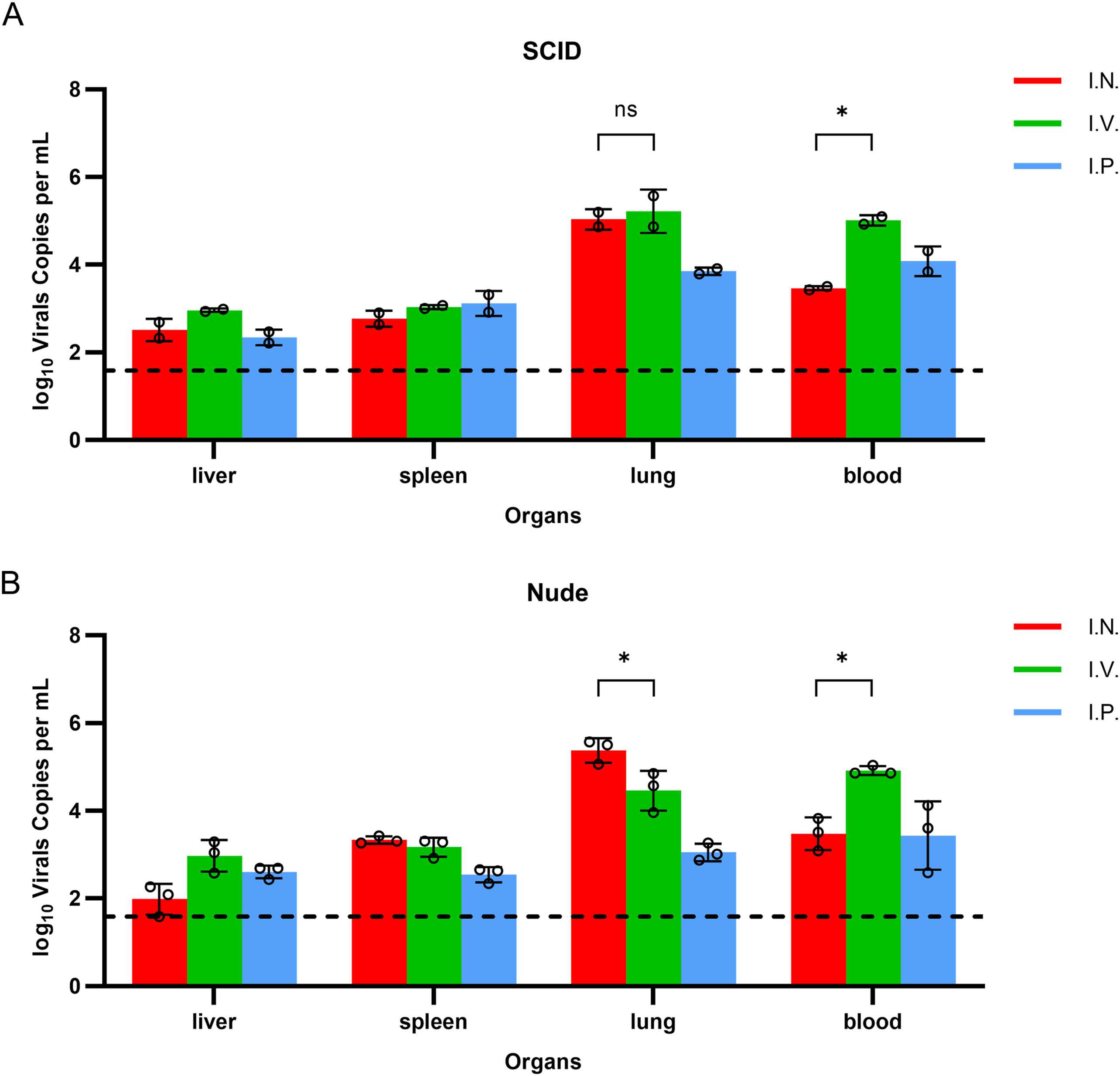
  • Monkeypox virus (MPXV), a member of the Orthopoxvirus genus, caused a large-scale global outbreak in 2022. Developing mouse models for MPXV infection is crucial for advancing research on vaccines and therapeutic interventions. To address this, we conducted a comparative study on the susceptibility of six mouse strains—severe combined immune-deficiency (SCID), nude, genetically diabetic (db/db) and obese (ob/ob), C57BL/6J, and BALB/c—to MPXV infection. Mouse strains were infected with MPXV via intranasal inoculation, and body weight changes and mortality were monitored post-infection. Additionally, the tissue distribution of MPXV and the pathological changes in the lung tissues of the infected mice were evaluated. The results demonstrated that SCID and nude mice exhibited significant weight loss following MPXV infection, with 100 % mortality observed in SCID mice, while no mortality occurred in nude mice. In contrast, the other mouse strains showed no significant weight loss or mortality. Notably, the viral load in the lung tissues of SCID and nude mice was the highest among the tested strains. Furthermore, we investigated the impact of different inoculation routes—intranasal (I.N.), intraperitoneal (I.P.), and intravenous (I.V.)—on the pathogenicity of MPXV in mice. The results revealed that the intravenous route induced more pronounced pathogenic effects compared to the intranasal and intraperitoneal routes. In summary, this study provides valuable insights into the development of MPXV-infected mouse models, offering a foundation for further research on MPXV pathogenesis and therapeutic drug development.

  • 加载中
    1. Americo, J.L., Earl, P.L., Moss, B., 2023. Virulence differences of mpox (monkeypox) virus clades I, IIa, and IIb.1 in a small animal model. Proc. Natl. Acad. Sci. U.S.A. 120, e2220415120.

    2. Americo, J.L., Moss, B., Earl, P.L., 2010. Identification of Wild-Derived Inbred Mouse Strains Highly Susceptible to Monkeypox Virus Infection for Use as Small Animal Models. J Virol 84, 8172-8180.

    3. Branche, A., Ramesh, M., Francis, B., 2024. A Narrative Review of Key Risk Factors for Severe Illness Following SARS-CoV-2, Influenza Virus, and Respiratory Syncytial Virus Infection. Infect Dis Ther 14, 39-61.

    4. Bunge, E.M., Hoet, B., Chen, L., Lienert, F., Weidenthaler, H., Baer, L.R., Steffen, R., 2022. The changing epidemiology of human monkeypox-A potential threat? A systematic review. PLoS Negl Trop Dis 16, e0010141.

    5. Chen, D., Yan, Y., Mei, T., Yang, P., Deng, S., Li, Y., Zhao, T., Xin, N., Duan, B., Liang, W., Yang, Y., Zhao, W., Seto, D., Ou, J., Zhang, Q., 2024. Construction and validation of a mouse model for studying severe human adenovirus infections. Virologica Sinica 39, 963-973.

    6. Coleman, D.L., 1978. Obese and diabetes: two mutant genes causing diabetes-obesity syndromes in mice. Diabetologia 14, 141-148.

    7. Earl, P.L., Americo, J.L., Moss, B., 2015. Genetic studies of the susceptibility of classical and wild-derived inbred mouse strains to monkeypox virus. Virology 481, 161-165.

    8. Everard, A., Lazarevic, V., Derrien, M., Girard, M., Muccioli, G.G., Neyrinck, A.M., Possemiers, S., Van Holle, A., Francois, P., de Vos, W.M., Delzenne, N.M., Schrenzel, J., Cani, P.D., 2011. Responses of gut microbiota and glucose and lipid metabolism to prebiotics in genetic obese and diet-induced leptin-resistant mice. Diabetes 60, 2775-2786.

    9. Geurts, L., Lazarevic, V., Derrien, M., Everard, A., Van Roye, M., Knauf, C., Valet, P., Girard, M., Muccioli, G.G., Francois, P., de Vos, W.M., Schrenzel, J., Delzenne, N.M., Cani, P.D., 2011. Altered gut microbiota and endocannabinoid system tone in obese and diabetic leptin-resistant mice: impact on apelin regulation in adipose tissue. Front Microbiol 2, 149.

    10. Giesbertz, P., Padberg, I., Rein, D., Ecker, J., Hofle, A.S., Spanier, B., Daniel, H., 2015. Metabolite profiling in plasma and tissues of ob/ob and db/db mice identifies novel markers of obesity and type 2 diabetes. Diabetologia 58, 2133-2143.

    11. Hennessee, I., Shelus, V., McArdle, C.E., Wolf, M., Schatzman, S., Carpenter, A., Minhaj, F.S., Petras, J.K., Cash-Goldwasser, S., Maloney, M., Sosa, L., Jones, S.A., Mangla, A.T., Harold, R.E., Beverley, J., Saunders, K.E., Adams, J.N., Stanek, D.R., Feldpausch, A., Pavlick, J., Cahill, M., O’Dell, V., Kim, M., Alarcon, J., Finn, L.E., Goss, M., Duwell, M., Crum, D.A., Williams, T.W., Hansen, K., Heddy, M., Mallory, K., McDermott, D., Cuadera, M.K.Q., Adler, E., Lee, E.H., Shinall, A., Thomas, C., Ricketts, E.K., Koonce, T., Rynk, D.B., Cogswell, K., McLafferty, M., Perella, D., Stockdale, C., Dell, B., Roskosky, M., White, S.L., Davis, K.R., Milleron, R.S., Mackey, S., Barringer, L.A., Bruce, H., Barrett, D., D’Angeli, M., Kocharian, A., Klos, R., Dawson, P., Ellington, S.R., Mayer, O., Godfred-Cato, S., Labuda, S.M., McCormick, D.W., McCollum, A.M., Rao, A.K., Salzer, J.S., Kimball, A., Gold, J.A.W., California Department of Public Health Monkeypox Pediatric Working Group, CDC Monkeypox Pediatric Working Group, 2022. Epidemiologic and Clinical Features of Children and Adolescents Aged <18 Years with Monkeypox - United States, May 17-September 24, 2022. MMWR Morb Mortal Wkly Rep 71, 1407-1411.

    12. Kumar, N., Acharya, A., Gendelman, H.E., Byrareddy, S.N., 2022. The 2022 outbreak and the pathobiology of the monkeypox virus. J Autoimmun 131, 102855.

    13. Laurenson-Schafer, H., Sklenovska, N., Hoxha, A., Kerr, S.M., Ndumbi, P., Fitzner, J., Almiron, M., de Sousa, L.A., Briand, S., Cenciarelli, O., Colombe, S., Doherty, M., Fall, I.S., Garcia-Calavaro, C., Haussig, J.M., Kato, M., Mahamud, A.R., Morgan, O.W., Nabeth, P., Naiene, J.D., Navegantes, W.A., Ogundiran, O., Okot, C., Pebody, R., Matsui, T., Ramirez, H.L.-G., Smallwood, C., Tasigchana, R.F.P., Vaughan, A.M., Williams, G.S., WHO mpox Surveillance and Analytics team, Mala, P.O., Lewis, R.F., Pavlin, B.I., le Polain de Waroux, O., 2023. Description of the first global outbreak of mpox: an analysis of global surveillance data. Lancet Glob Health 11, e1012-e1023.

    14. Osorio, J.E., Iams, K.P., Meteyer, C.U., Rocke, T.E., 2009. Comparison of monkeypox viruses pathogenesis in mice by in vivo imaging. PLoS One 4, e6592.

    15. Zhu, M., Ji, J., Shi, D., Lu, X., Wang, B., Wu, N., Wu, J., Yao, H., Li, L., 2022. Unusual global outbreak of monkeypox: what should we do? Front Med 16, 507-517.

  • 加载中

Figures(1)

Article Metrics

Article views(4490) PDF downloads(14) Cited by(0)

Related
Proportional views
    通讯作者: 陈斌, bchen63@163.com
    • 1. 

      沈阳化工大学材料科学与工程学院 沈阳 110142

    1. 本站搜索
    2. 百度学术搜索
    3. 万方数据库搜索
    4. CNKI搜索

    Differential susceptibility of immunodeficient mice to MPXV infection and the impact of various inoculation routes

      Corresponding author: Changbo Ou, ouchangbo@gxu.edu.cn
      Corresponding author: Xiao Li, lixiao06@mails.jlu.edu.cn
      Corresponding author: Zongzheng Zhao, 329517286@qq.com
    • a. Guangxi University, Nanning, 530004, China;
    • b. Changchun Veterinary Research Institute, Chinese Academy of Agriculture Sciences, Changchun, 130122, China;
    • c. Hebei Agricultural University, Baoding, 071000, China;
    • d. Jilin Agricultural University, Changchun, 130118, China

    Abstract: Monkeypox virus (MPXV), a member of the Orthopoxvirus genus, caused a large-scale global outbreak in 2022. Developing mouse models for MPXV infection is crucial for advancing research on vaccines and therapeutic interventions. To address this, we conducted a comparative study on the susceptibility of six mouse strains—severe combined immune-deficiency (SCID), nude, genetically diabetic (db/db) and obese (ob/ob), C57BL/6J, and BALB/c—to MPXV infection. Mouse strains were infected with MPXV via intranasal inoculation, and body weight changes and mortality were monitored post-infection. Additionally, the tissue distribution of MPXV and the pathological changes in the lung tissues of the infected mice were evaluated. The results demonstrated that SCID and nude mice exhibited significant weight loss following MPXV infection, with 100 % mortality observed in SCID mice, while no mortality occurred in nude mice. In contrast, the other mouse strains showed no significant weight loss or mortality. Notably, the viral load in the lung tissues of SCID and nude mice was the highest among the tested strains. Furthermore, we investigated the impact of different inoculation routes—intranasal (I.N.), intraperitoneal (I.P.), and intravenous (I.V.)—on the pathogenicity of MPXV in mice. The results revealed that the intravenous route induced more pronounced pathogenic effects compared to the intranasal and intraperitoneal routes. In summary, this study provides valuable insights into the development of MPXV-infected mouse models, offering a foundation for further research on MPXV pathogenesis and therapeutic drug development.

    Figure (1)  Reference (15) Relative (20)

    目录

    /

    DownLoad:  Full-Size Img  PowerPoint
    Return
    Return